ExamineAI
First page of Tertiary Economics Revision Pack Zimbabwe

Tertiary Economics Revision Pack Zimbabwe

Study Economics revision pack for Tertiary. Useful for revision, homework, and exam preparation in Zimbabwe.

A free account is needed to download. Sign in or create one

Subject
Economics
Document
Revision Pack
Session
Spring
Year
2012
File
PDF, 1.6 MB

About this revision pack

This is the Economics revision pack from Spring 2012. It is a free revision pack for revision.

Other years: Economics

Text from the first page

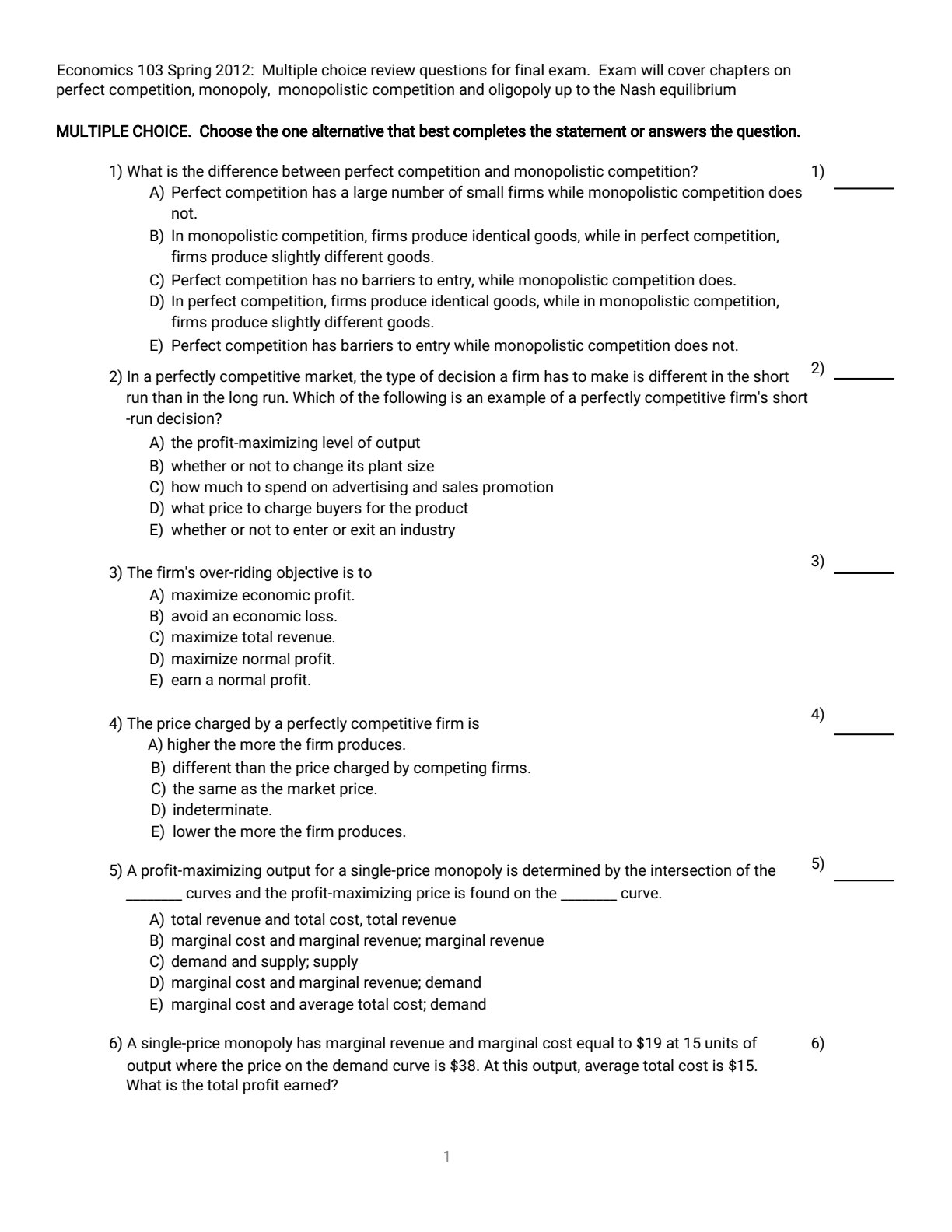
Economics 103 Spring 2012: Multiple choice review questions for final exam. Exam will cover chapters on perfect competition, monopoly, monopolistic competition and oligopoly up to the Nash equilibrium

MULTIPLE CHOICE. Choose the one alternative that best completes the statement or answers the question.
1) What is the difference between perfect competition and monopolistic competition?
A) Perfect competition has a large number of small firms while monopolistic competition does

1) not.
B) In monopolistic competition, firms produce identical goods, while in perfect competition, firms produce slightly different goods.
C) Perfect competition has no barriers to entry, while monopolistic competition does.
D) In perfect competition, firms produce identical goods, while in monopolistic competition, firms produce slightly different goods.
E) Perfect competition has barriers to entry while monopolistic competition does not.
2) In a perfectly competitive market, the type of decision a firm has to make is different in the short run than in the long run. Which of the following is an example of a perfectly competitive firm's short -run decision?
A) the profit-maximizing level of output
B) whether or not to change its plant size
C) how much to spend on advertising and sales promotion
D) what price to charge buyers for the product
E) whether or not to enter or exit an industry
3) The firm's over-riding objective is to
A) maximize economic profit.
B) avoid an economic loss.
C) maximize total revenue.
D) maximize normal profit.
E) earn a normal profit.
4) The price charged by a perfectly competitive firm is
A) higher the more the firm produces.
B) different than the price charged by competing firms.
C) the same as the market price.
D) indeterminate.
E) lower the more the firm produces.
5) A profit-maximizing output for a single-price monopoly is determined by the intersection of the
$\_\_\_\_$ curves and the profit-maximizing price is found on the $\_\_\_\_$ curve.
A) total revenue and total cost, total revenue
B) marginal cost and marginal revenue; marginal revenue
C) demand and supply; supply
D) marginal cost and marginal revenue; demand
E) marginal cost and average total cost; demand
6) A single-price monopoly has marginal revenue and marginal cost equal to $$ 19$ at 15 units of

6) output where the price on the demand curve is $$ 38$. At this output, average total cost is $$ 15$. What is the total profit earned?

1