Subject-Verb Agreement
Subject-Verb Agreement. Free PDF download (101 KB) from the ExamineAI past papers library.
A free account is needed to download. Sign in or create one
- Subject
- English Language
- Document
- Worksheet
- File
- PDF, 101 KB
Subject-Verb Agreement. Free PDF download (101 KB) from the ExamineAI past papers library.
A free account is needed to download. Sign in or create one
This is the English Language worksheet. It is a free worksheet for revision.
Subject-Verb Agreement
A "grammar help worksheet" by Abbie Potter Henry
(Subjects are in bold typeface and verbs are underlined)
Subject-Verb Agreement means that subjects and verbs must always agree in number. Not only does a verb change its form to tell time, but it also can change its form to indicate how many subjects it has.

For example, take the verb "run." When we are in the present tense, the verb "run" changes form to show that its subject is singular when its subject is anything but "I" or "you."

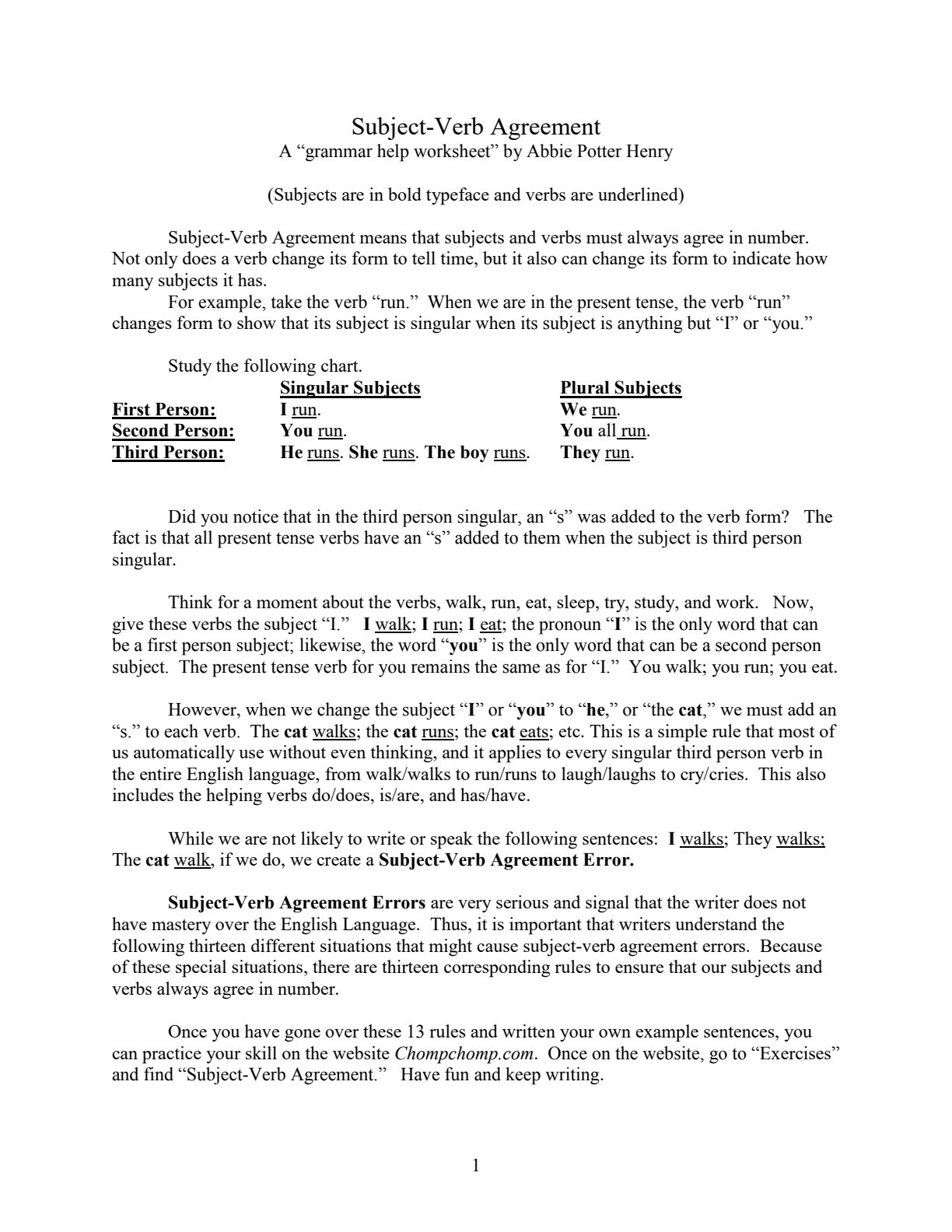
Study the following chart.

Singular Subjects
First Person:
Second Person:
Third Person:

I run.
You run.
He runs. She runs. The boy runs.

Plural Subjects
We run.
You all run.
They run.

Did you notice that in the third person singular, an " s " was added to the verb form? The fact is that all present tense verbs have an " $s$ " added to them when the subject is third person singular.

Think for a moment about the verbs, walk, run, eat, sleep, try, study, and work. Now, give these verbs the subject "I." I walk; I run; I eat; the pronoun "I " is the only word that can be a first person subject; likewise, the word "you" is the only word that can be a second person subject. The present tense verb for you remains the same as for "I." You walk; you run; you eat.

However, when we change the subject " $\mathbf{I}$ " or "you" to "he," or "the cat," we must add an "s." to each verb. The cat walks; the cat runs; the cat eats; etc. This is a simple rule that most of us automatically use without even thinking, and it applies to every singular third person verb in the entire English language, from walk/walks to run/runs to laugh/laughs to cry/cries. This also includes the helping verbs do/does, is/are, and has/have.

While we are not likely to write or speak the following sentences: I walks; They walks; The cat walk, if we do, we create a Subject-Verb Agreement Error.

Subject-Verb Agreement Errors are very serious and signal that the writer does not have mastery over the English Language. Thus, it is important that writers understand the following thirteen different situations that might cause subject-verb agreement errors. Because of these special situations, there are thirteen corresponding rules to ensure that our subjects and verbs always agree in number.

Once you have gone over these 13 rules and written your own example sentences, you can practice your skill on the website Chompchomp.com. Once on the website, go to "Exercises" and find "Subject-Verb …