ExamineAI
First page of Statistics Time Series Analysis Notes Zimbabwe

Statistics Time Series Analysis Notes Zimbabwe

Study Statistics notes on Time Series Analysis. Useful for revision, homework, and exam preparation in Zimbabwe.

A free account is needed to download. Sign in or create one

Subject
Statistics
Document
Notes
File
PDF, 795 KB

About this notes

This is the Statistics notes. It is a free notes for revision.

More Statistics papers

Other years: Statistics

Text from the first page

TIME SERIES ANALYSIS

Time Series
Time series is data that has been classified chronologically or numerical data that is described over a uniform set of time.
Time series analysis is the evaluation and extraction of the components of a model that 'breakdown " a particular series into understandable and explainable portions. Time series models attempt to predict the future using historical data. These models make the assumption that what happens in the future is a function of what happened in the past. Time series analysis consists of (a) time series decomposition or breaking the series down into its characteristic variations. (b) projecting each characteristic into the future. (c) adding together all the individual projections to arrive at one forecast figure for the complete time series.

Components of a Time Series
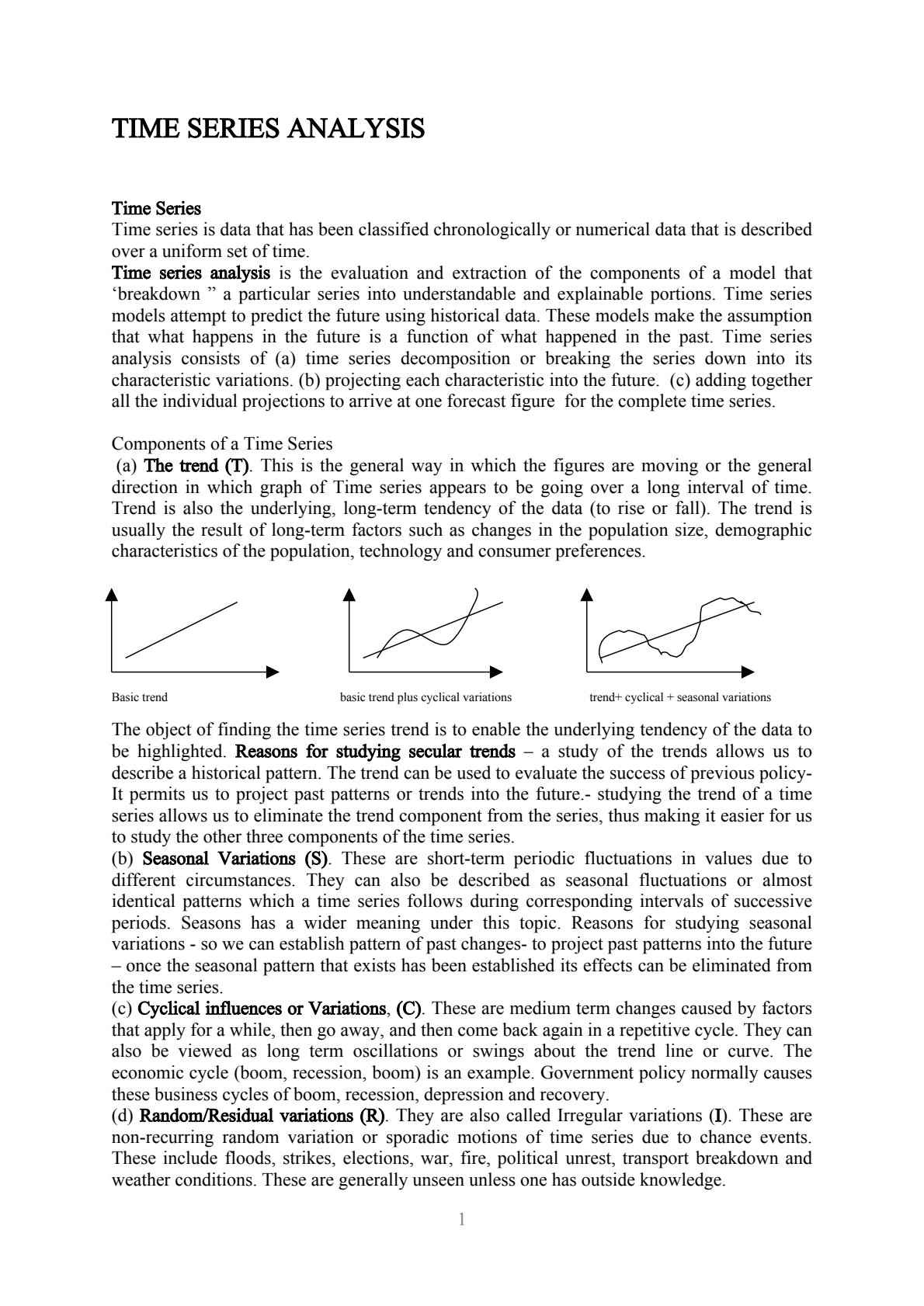
(a) The trend (T). This is the general way in which the figures are moving or the general direction in which graph of Time series appears to be going over a long interval of time. Trend is also the underlying, long-term tendency of the data (to rise or fall). The trend is usually the result of long-term factors such as changes in the population size, demographic characteristics of the population, technology and consumer preferences.

Basic trend

basic trend plus cyclical variations

trend+ cyclical + seasonal variations

The object of finding the time series trend is to enable the underlying tendency of the data to be highlighted. Reasons for studying secular trends - a study of the trends allows us to describe a historical pattern. The trend can be used to evaluate the success of previous policyIt permits us to project past patterns or trends into the future.- studying the trend of a time series allows us to eliminate the trend component from the series, thus making it easier for us to study the other three components of the time series.
(b) Seasonal Variations (S). These are short-term periodic fluctuations in values due to different circumstances. They can also be described as seasonal fluctuations or almost identical patterns which a time series follows during corresponding intervals of successive periods. Seasons has a wider meaning under this topic. Reasons for studying seasonal variations - so we can establish pattern of past changes- to project past patterns into the future - once the seasonal pattern that exists has been established its effects can be eliminated from the time series.
(c) Cyclical influences or Variations, (C). These …