ExamineAI
First page of Secondary Mathematics Scale Notes Zimbabwe

Secondary Mathematics Scale Notes Zimbabwe

Study Mathematics notes on Scale for Secondary. Useful for revision, homework, and exam preparation in Zimbabwe.

A free account is needed to download. Sign in or create one

Subject
Mathematics
Document
Notes
File
PDF, 376 KB

About this notes

This is the Mathematics notes. It is a free notes for revision.

More Mathematics papers

Other years: Mathematics

Text from the first page

7. 5 men can complete a certain task in 9 days.

Find the time that:
a) 3 men will take to complete the same task if working at the same rate.
b) 8 men will take to complete the same task if working at the same rate.
8. A certain chemical costing $$ 137,50 / 50 \mathrm{~kg}$ is mixed with another chemical costing $$ 112,50 / 50 \mathrm{~kg}$. If the mixture is sold at $$ 173,55 / 50 \mathrm{~kg}$ calculate the percentage profit per kg to the nearest whole number.
D. SCALE

Map scales are linear. This means they give a relationship between
distance on a map and the actual distance on the ground. Scale can be given in several ways, for example, 1 cm to represent 20 m can be given as $1 \mathrm{~cm}: 20 \mathrm{~m}$ or $1: 2000$ or 1 cm to 2000 cm or $\frac{1}{2000}$ All this means is that 1 cm on the map represents 20 m on the ground. The scale with components reduced to the same basic unit is often called the Representative Fraction (RF) of the map. Remember that
\[
R F=\frac{\text { Distance between two points on the map }}{\text { Distance between the same points on the ground }}
\]

Thus if a map gives a scale of 1 cm to $\frac{1}{2} \mathrm{~km}$,
\[
\mathrm{RF}=\frac{1}{50000} \text { or } 1: 50000
\]

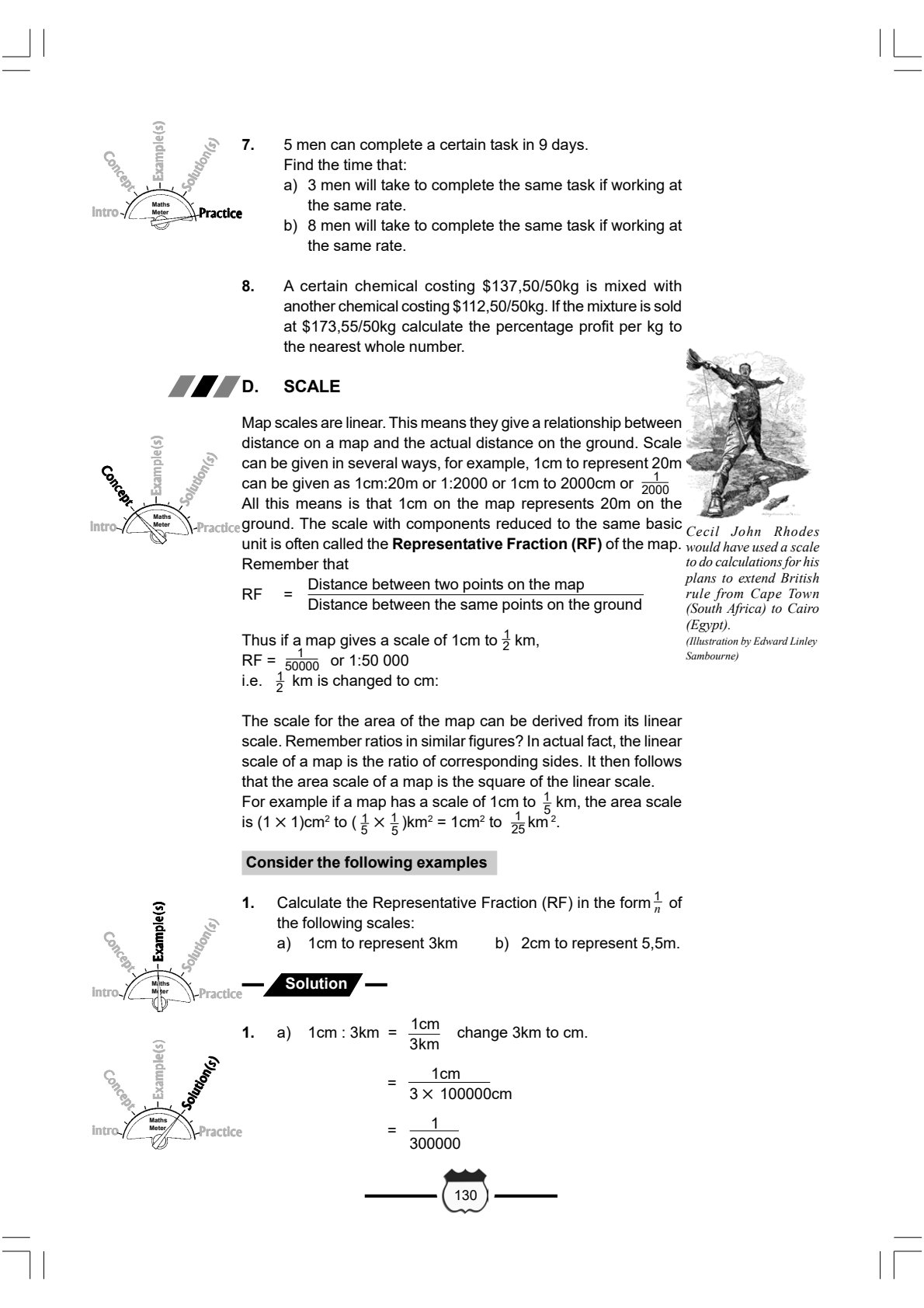
Cecil John Rhodes
would have used a scale to do calculations for his plans to extend British rule from Cape Town (South Africa) to Cairo (Egypt).
(Illustration by Edward Linley Sambourne)
i.e. $\frac{1}{2} \mathrm{~km}$ is changed to cm :
The scale for the area of the map can be derived from its linear scale. Remember ratios in similar figures? In actual fact, the linear scale of a map is the ratio of corresponding sides. It then follows that the area scale of a map is the square of the linear scale. For example if a map has a scale of 1 cm to $\frac{1}{5} \mathrm{~km}$, the area scale is $(1 \times 1) \mathrm{cm}^{2}$ to $\left(\frac{1}{5} \times \frac{1}{5}\right) \mathrm{km}^{2}=1 \mathrm{~cm}^{2}$ to $\frac{1}{25} \mathrm{~km}^{2}$.

Consider the following examples
1. Calculate the Representative Fraction (RF) in the form $\frac{1}{n}$ of the following scales:
a) 1 cm to represent 3 km
b) 2 cm to represent $5,5 \mathrm{~m}$.

Solution
1. a) $1 \mathrm{~cm}: 3 \mathrm{~km}=\frac{1 \mathrm{~cm}}{3 \mathrm{~km}}$ change 3 km to cm .
\[
\begin{array}{l}
=\frac{1 \mathrm{~cm}}{3 \times 100000 \mathrm{~cm}}
=\frac{1}{300000}
\end{array}
\]

130