ExamineAI
First page of Secondary Geography The Restless Earth Notes Zimbabwe

Secondary Geography The Restless Earth Notes Zimbabwe

Study Geography notes on The Restless Earth for Secondary. Useful for revision, homework, and exam preparation in Zimbabwe.

A free account is needed to download. Sign in or create one

Subject
Geography
Document
Notes
File
PDF, 1.6 MB

About this notes

This is the Geography notes. It is a free notes for revision.

More Geography papers

Other years: Geography

Text from the first page

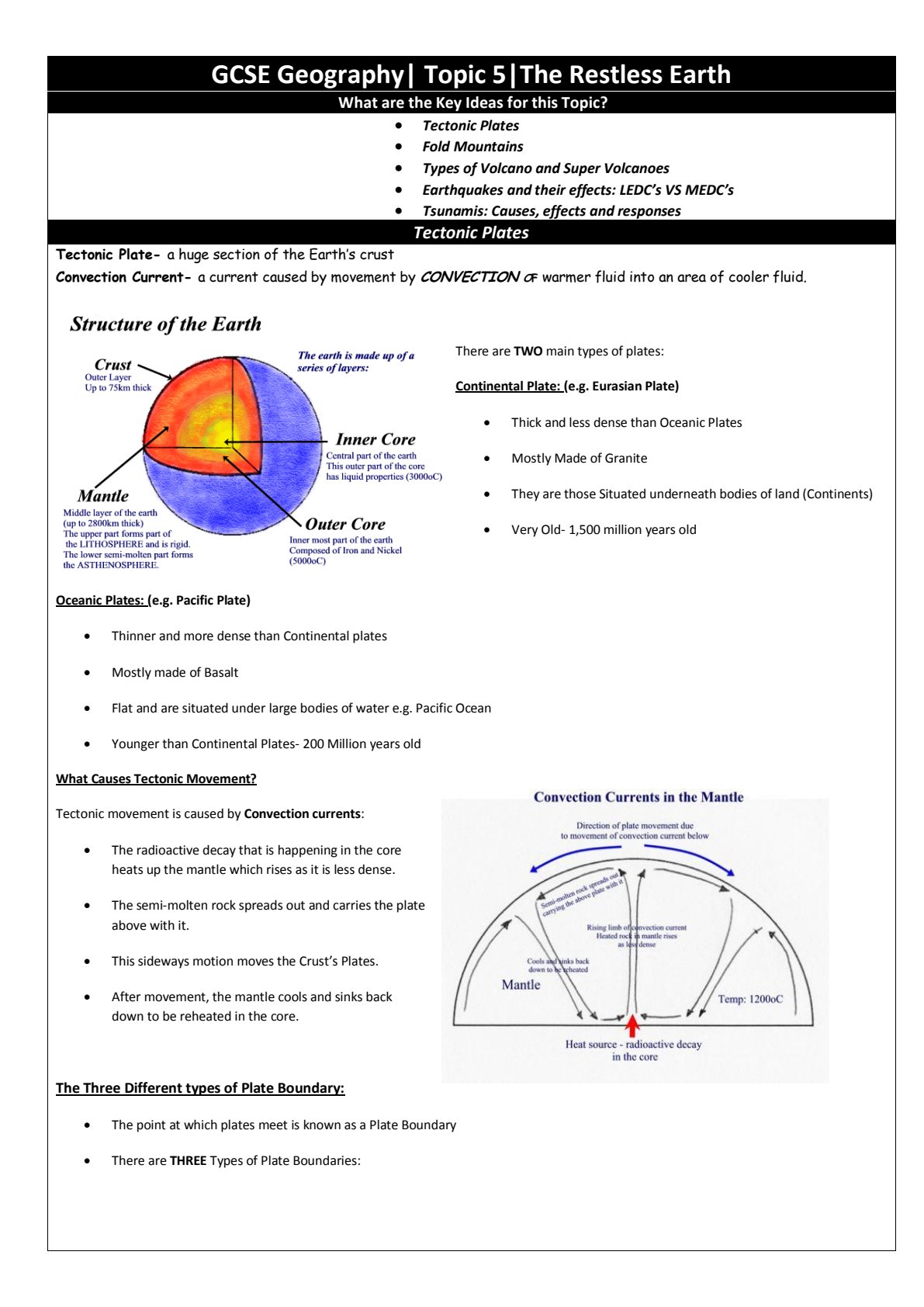
GCSE Geographyl Topic 5|The Restless Earth
What are the Key Ideas for this Topic?
- Tectonic Plates
- Fold Mountains
- Types of Volcano and Super Volcanoes
- Earthquakes and their effects: LEDC's VS MEDC's
- Tsunamis: Causes, effects and responses

Tectonic Plates
Tectonic Plate- a huge section of the Earth's crust
Convection Current- a current caused by movement by CONVECTION of warmer fluid into an area of cooler fluid.
Structure of the Earth

There are TWO main types of plates:

Continental Plate: (e.g. Eurasian Plate)
- Thick and less dense than Oceanic Plates
- Mostly Made of Granite
- They are those Situated underneath bodies of land (Continents)
- Very Old- 1,500 million years old

Oceanic Plates: (e.g. Pacific Plate)
- Thinner and more dense than Continental plates
- Mostly made of Basalt
- Flat and are situated under large bodies of water e.g. Pacific Ocean
- Younger than Continental Plates- 200 Million years old

What Causes Tectonic Movement?

Tectonic movement is caused by Convection currents:
- The radioactive decay that is happening in the core heats up the mantle which rises as it is less dense.
- The semi-molten rock spreads out and carries the plate above with it.
- This sideways motion moves the Crust's Plates.
- After movement, the mantle cools and sinks back down to be reheated in the core.

Convection Currents in the Mantle

The Three Different types of Plate Boundary:
- The point at which plates meet is known as a Plate Boundary
- There are THREE Types of Plate Boundaries: