ExamineAI
First page of Secondary English Language Literary Analysis Notes Zimbabwe

Secondary English Language Literary Analysis Notes Zimbabwe

Study English Language notes on Literary Analysis for Secondary. Useful for revision, homework, and exam preparation in Zimbabwe.

A free account is needed to download. Sign in or create one

Subject
English Language
Document
Notes
File
PDF, 154 KB

About this notes

This is the English Language notes. It is a free notes for revision.

More English Language papers

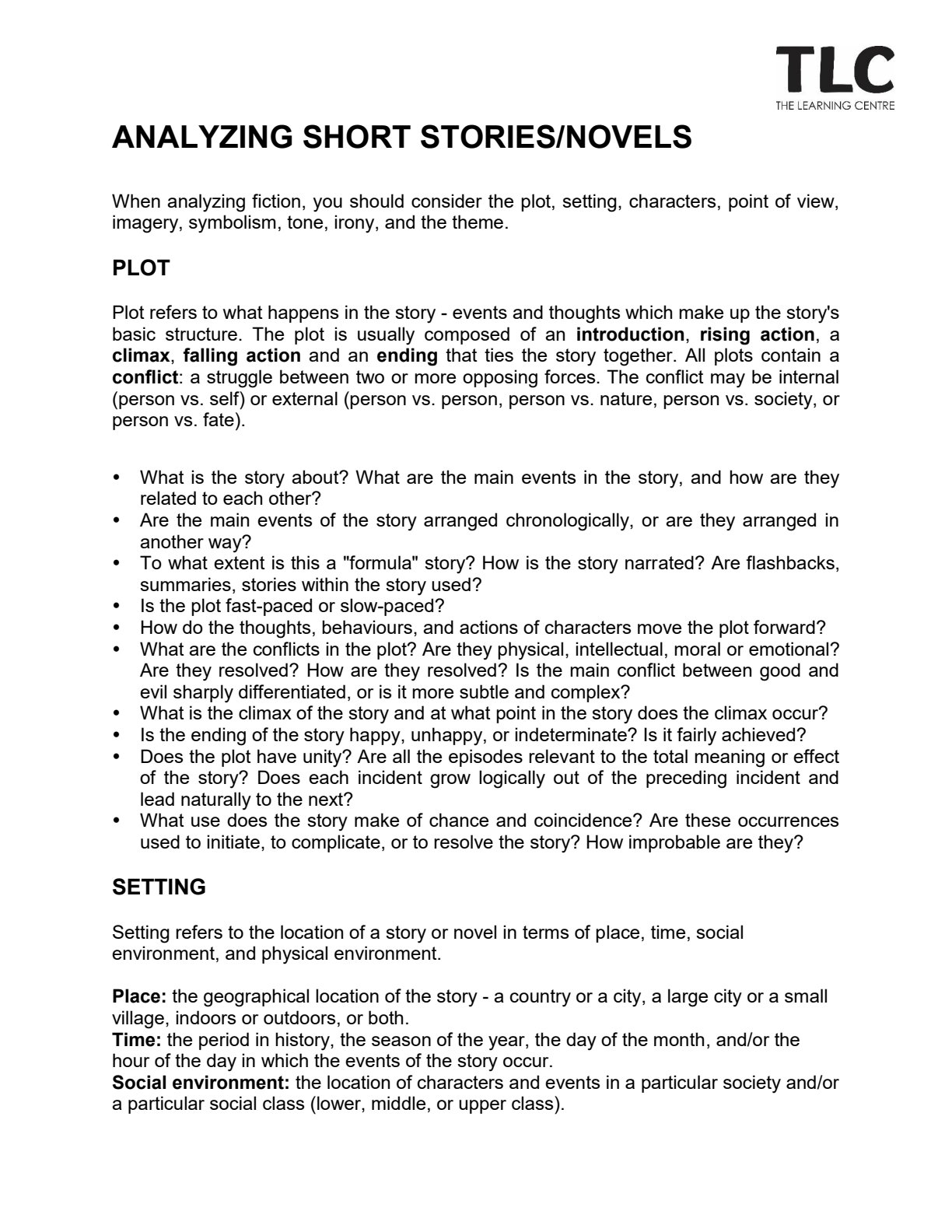
Text from the first page

TLC
THE LEARNING CENTRE

ANALYZING SHORT STORIES/NOVELS

When analyzing fiction, you should consider the plot, setting, characters, point of view, imagery, symbolism, tone, irony, and the theme.

PLOT
Plot refers to what happens in the story - events and thoughts which make up the story's basic structure. The plot is usually composed of an introduction, rising action, a climax, falling action and an ending that ties the story together. All plots contain a conflict: a struggle between two or more opposing forces. The conflict may be internal (person vs. self) or external (person vs. person, person vs. nature, person vs. society, or person vs. fate).
- What is the story about? What are the main events in the story, and how are they related to each other?
- Are the main events of the story arranged chronologically, or are they arranged in another way?
- To what extent is this a "formula" story? How is the story narrated? Are flashbacks, summaries, stories within the story used?
- Is the plot fast-paced or slow-paced?
- How do the thoughts, behaviours, and actions of characters move the plot forward?
- What are the conflicts in the plot? Are they physical, intellectual, moral or emotional? Are they resolved? How are they resolved? Is the main conflict between good and evil sharply differentiated, or is it more subtle and complex?
- What is the climax of the story and at what point in the story does the climax occur?
- Is the ending of the story happy, unhappy, or indeterminate? Is it fairly achieved?
- Does the plot have unity? Are all the episodes relevant to the total meaning or effect of the story? Does each incident grow logically out of the preceding incident and lead naturally to the next?
- What use does the story make of chance and coincidence? Are these occurrences used to initiate, to complicate, or to resolve the story? How improbable are they?

SETTING
Setting refers to the location of a story or novel in terms of place, time, social environment, and physical environment.

Place: the geographical location of the story - a country or a city, a large city or a small village, indoors or outdoors, or both.
Time: the period in history, the season of the year, the day of the month, and/or the hour of the day in which the events of the story occur.
Social environment: the location of characters and events in a particular society and/or a particular social class (lower, middle, or upper class).