ExamineAI
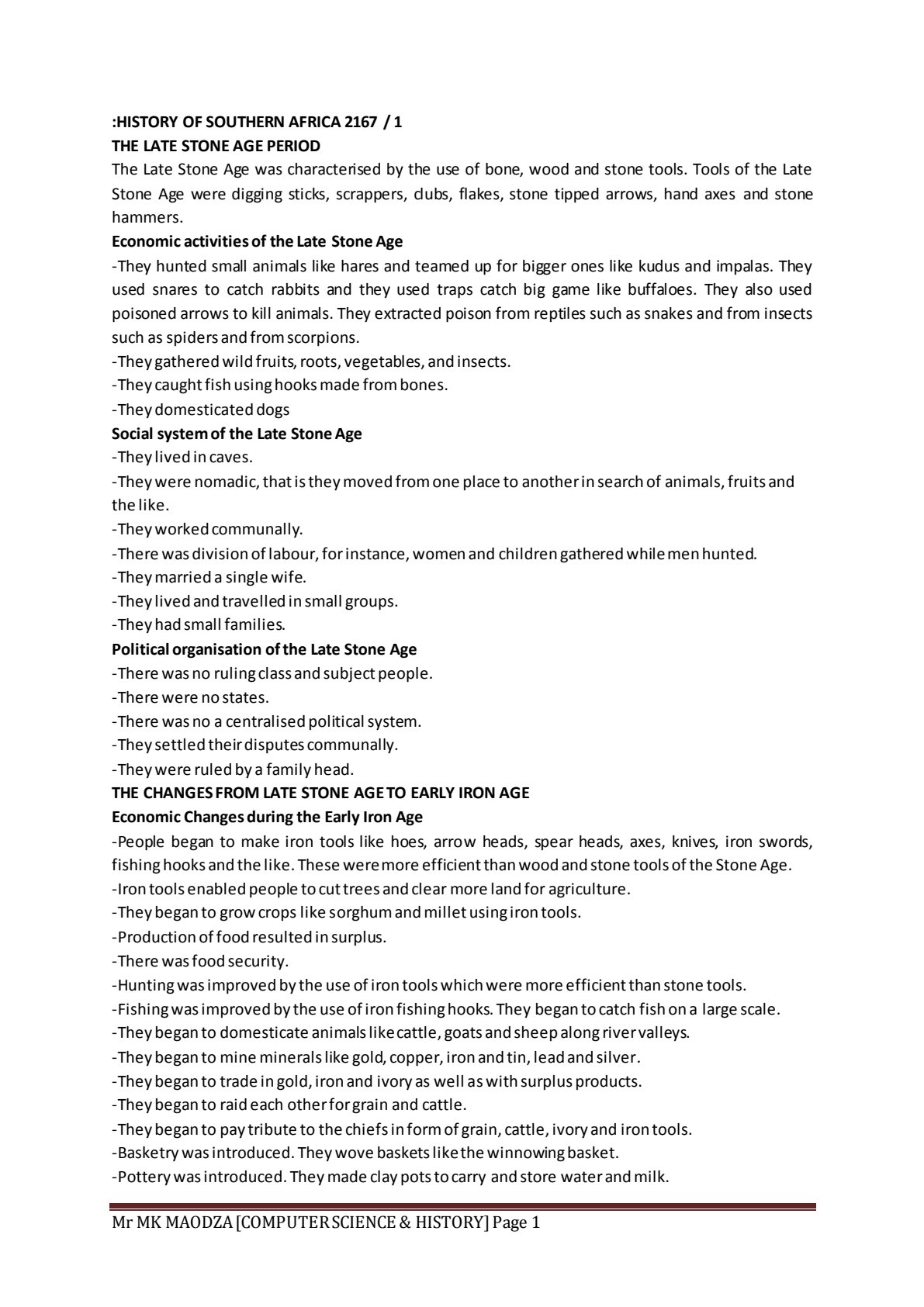
First page of O-Level History Late Stone Age Notes Zimbabwe

O-Level History Late Stone Age Notes Zimbabwe

Study History notes on Late Stone Age for O-Level. Useful for revision, homework, and exam preparation in Zimbabwe.

A free account is needed to download. Sign in or create one

Subject
History
Level
O-Level
Document
Notes
Paper code
2167/1
File
PDF, 1014 KB

About this notes

This is the O-Level History notes. It is a free notes for revision. The paper code is 2167/1.

More History O-Level papers

Other years: History O-Level

Text from the first page

:HISTORY OF SOUTHERN AFRICA 2167 / 1
THE LATE STONE AGE PERIOD
The Late Stone Age was characterised by the use of bone, wood and stone tools. Tools of the Late Stone Age were digging sticks, scrappers, dubs, flakes, stone tipped arrows, hand axes and stone hammers.
Economic activities of the Late Stone Age
-They hunted small animals like hares and teamed up for bigger ones like kudus and impalas. They used snares to catch rabbits and they used traps catch big game like buffaloes. They also used poisoned arrows to kill animals. They extracted poison from reptiles such as snakes and from insects such as spiders and from scorpions.
-They gathered wild fruits, roots, vegetables, and insects.
-They caught fish using hooks made from bones.
-They domesticated dogs
Social system of the Late Stone Age
-They lived in caves.
-They were nomadic, that is they moved from one place to another in search of animals, fruits and the like.
-They worked communally.
-There was division of labour, for instance, women and children gathered while men hunted.
-They married a single wife.
-They lived and travelled in small groups.
-They had small families.
Political organisation of the Late Stone Age
-There was no ruling class and subject people.
-There were no states.
-There was no a centralised political system.
-They settled their disputes communally.
-They were ruled by a family head.
THE CHANGES FROM LATE STONE AGE TO EARLY IRON AGE
Economic Changes during the Early Iron Age
-People began to make iron tools like hoes, arrow heads, spear heads, axes, knives, iron swords, fishing hooks and the like. These were more efficient than wood and stone tools of the Stone Age.
-Iron tools enabled people to cut trees and clear more land for agriculture.
-They began to grow crops like sorghum and millet using iron tools.
-Production of food resulted in surplus.
-There was food security.
-Hunting was improved by the use of iron tools which were more efficient than stone tools.
-Fishing was improved by the use of iron fishing hooks. They began to catch fish on a large scale.
-They began to domesticate animals like cattle, goats and sheep along river valleys.
-They began to mine minerals like gold, copper, iron and tin, lead and silver.
-They began to trade in gold, iron and ivory as well as with surplus products.
-They began to raid each other for grain and cattle.
-They began to pay tribute to the chiefs in form of grain, cattle, ivory and iron tools.
-Basketry was introduced. They wove …