ExamineAI
First page of O-Level Computer Science Notes Zimbabwe

O-Level Computer Science Notes Zimbabwe

Study Computer Science notes for O-Level. Useful for revision, homework, and exam preparation in Zimbabwe.

A free account is needed to download. Sign in or create one

Exam board
ZIMSEC
Subject
Computer Science
Level
O-Level
Document
Notes
Year
2011
File
PDF, 1.1 MB

About this notes

This is the ZIMSEC O-Level Computer Science notes from 2011. It is a free notes for revision.

Other years: Computer Science O-Level

Text from the first page

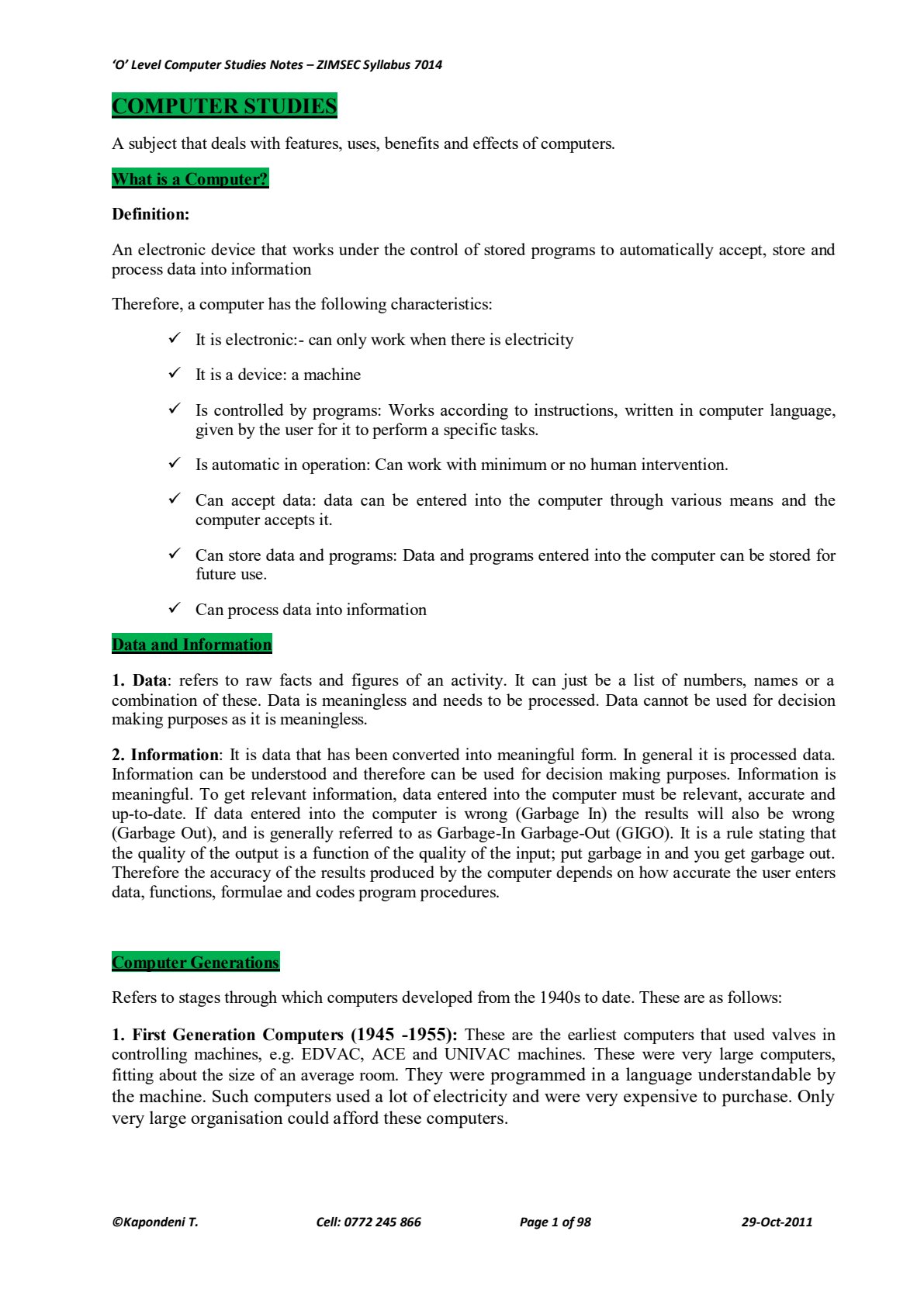
'O' Level Computer Studies Notes - ZIMSEC Syllabus 7014

COMPUTER STUDIES
A subject that deals with features, uses, benefits and effects of computers.
What is a Computer?
Definition:
An electronic device that works under the control of stored programs to automatically accept, store and process data into information

Therefore, a computer has the following characteristics:
✓ It is electronic:- can only work when there is electricity
✓ It is a device: a machine
✓ Is controlled by programs: Works according to instructions, written in computer language, given by the user for it to perform a specific tasks.
✓ Is automatic in operation: Can work with minimum or no human intervention.
✓ Can accept data: data can be entered into the computer through various means and the computer accepts it.
✓ Can store data and programs: Data and programs entered into the computer can be stored for future use.
✓ Can process data into information

Data and Information
1. Data: refers to raw facts and figures of an activity. It can just be a list of numbers, names or a combination of these. Data is meaningless and needs to be processed. Data cannot be used for decision making purposes as it is meaningless.
2. Information: It is data that has been converted into meaningful form. In general it is processed data. Information can be understood and therefore can be used for decision making purposes. Information is meaningful. To get relevant information, data entered into the computer must be relevant, accurate and up-to-date. If data entered into the computer is wrong (Garbage In) the results will also be wrong (Garbage Out), and is generally referred to as Garbage-In Garbage-Out (GIGO). It is a rule stating that the quality of the output is a function of the quality of the input; put garbage in and you get garbage out. Therefore the accuracy of the results produced by the computer depends on how accurate the user enters data, functions, formulae and codes program procedures.

Computer Generations
Refers to stages through which computers developed from the 1940s to date. These are as follows:
1. First Generation Computers (1945-1955): These are the earliest computers that used valves in controlling machines, e.g. EDVAC, ACE and UNIVAC machines. These were very large computers, fitting about the size of an average room. They were programmed in a language understandable by the machine. Such computers used a lot of electricity and were very expensive to purchase. Only very large …