ExamineAI
First page of O-Level Chemistry Metals Notes Zimbabwe

O-Level Chemistry Metals Notes Zimbabwe

Study Chemistry notes on Metals for O-Level. Useful for revision, homework, and exam preparation in Zimbabwe.

A free account is needed to download. Sign in or create one

Subject
Chemistry
Level
O-Level
Document
Notes
File
PDF, 1.3 MB

About this notes

This is the O-Level Chemistry notes. It is a free notes for revision.

More Chemistry O-Level papers

Other years: Chemistry O-Level

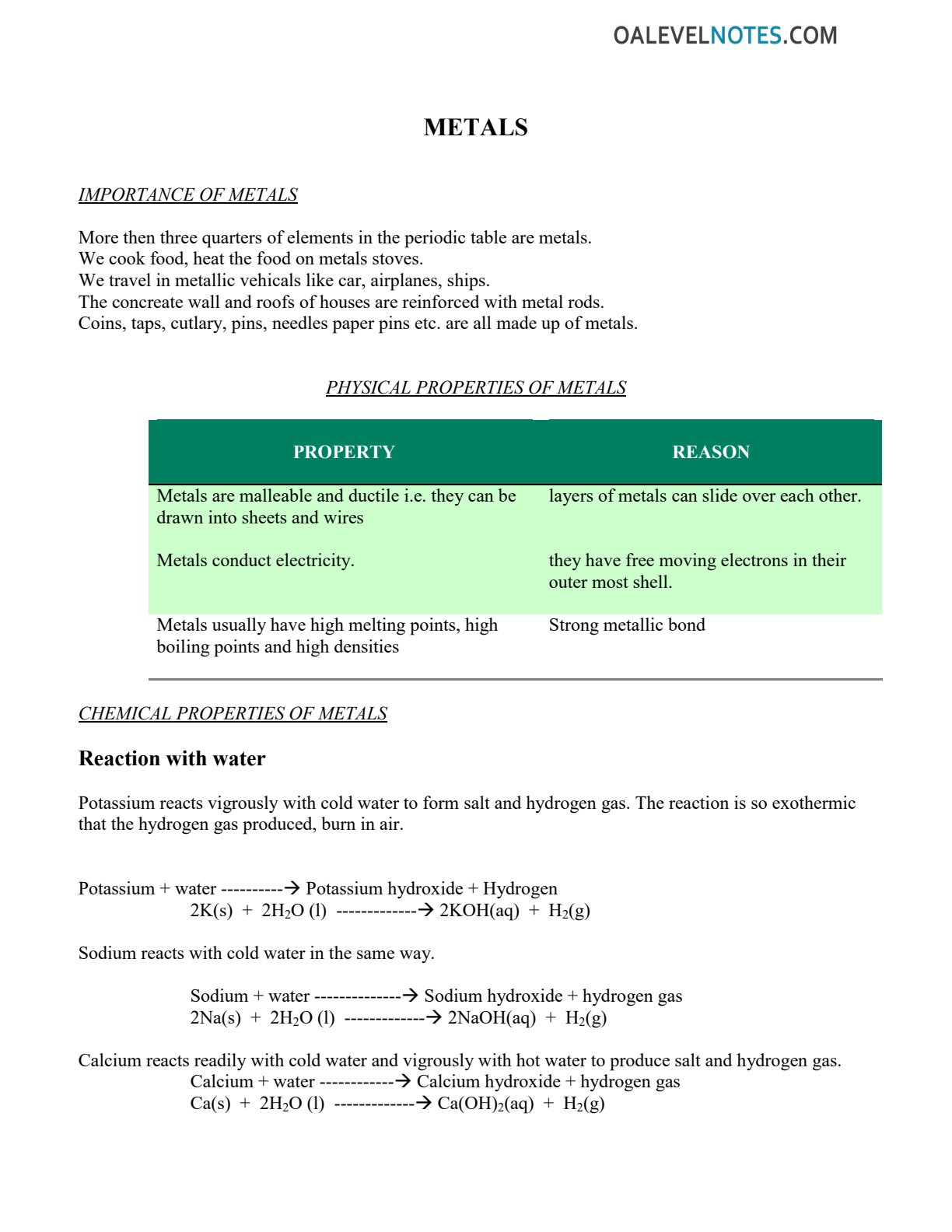
Text from the first page

OALEVELNOTES.COM

METALS

IMPORTANCE OF METALS
More then three quarters of elements in the periodic table are metals.
We cook food, heat the food on metals stoves.
We travel in metallic vehicals like car, airplanes, ships.
The concreate wall and roofs of houses are reinforced with metal rods.
Coins, taps, cutlary, pins, needles paper pins etc. are all made up of metals.

PHYSICAL PROPERTIES OF METALS

 PROPERTY  |  REASON
 Metals are malleable and ductile i.e. they can be drawn into sheets and wires  |  layers of metals can slide over each other.
 Metals conduct electricity.  |  they have free moving electrons in their outer most shell.
 Metals usually have high melting points, high boiling points and high densities  |  Strong metallic bond

CHEMICAL PROPERTIES OF METALS
Reaction with water
Potassium reacts vigrously with cold water to form salt and hydrogen gas. The reaction is so exothermic that the hydrogen gas produced, burn in air.
\[
\begin{array}{l}
\text { Potassium }+ \text { water → } \text { Potassium hydroxide + Hydrogen }
2 \mathrm{~K}(\mathrm{~s})+2 \mathrm{H}_{2} \mathrm{O}(\mathrm{l})------------2 \mathrm{KOH}(\mathrm{aq})+\mathrm{H}_{2}(\mathrm{~g})
\end{array}
\]

Sodium reacts with cold water in the same way.
\[
\begin{array}{l}
\text { Sodium + water → Sodium hydroxide + hydrogen gas }
2 \mathrm{Na}(\mathrm{~s})+2 \mathrm{H}_{2} \mathrm{O}(\mathrm{l})-\cdots 2 \mathrm{NaOH}(\mathrm{aq})+\mathrm{H}_{2}(\mathrm{~g})
\end{array}
\]

Calcium reacts readily with cold water and vigrously with hot water to produce salt and hydrogen gas.
\[
\begin{array}{l}
\text { Calcium + water } \rightarrow \rightarrow \rightarrow \rightarrow \rightarrow \rightarrow \rightarrow \rightarrow \rightarrow \rightarrow \rightarrow \rightarrow \rightarrow \rightarrow \rightarrow \rightarrow \rightarrow \rightarrow \rightarrow \rightarrow \rightarrow \rightarrow \rightarrow \rightarrow \rightarrow \rightarrow \rightarrow \rightarrow
\end{array} \text { Calcium hydroxide + hydrogen gas }
\]