ExamineAI
First page of O-Level Chemistry Classification and Nomenclature of Organic Compounds Notes Zimbabwe

O-Level Chemistry Classification and Nomenclature of Organic Compounds Notes Zimbabwe

Study Chemistry notes on Classification and Nomenclature of Organic Compounds for O-Level. Useful for revision, homework, and exam preparation in Zimbabwe.

A free account is needed to download. Sign in or create one

Subject
Chemistry
Level
O-Level
Document
Notes
File
PDF, 5.0 MB

About this notes

This is the O-Level Chemistry notes. It is a free notes for revision.

More Chemistry O-Level papers

Other years: Chemistry O-Level

Text from the first page

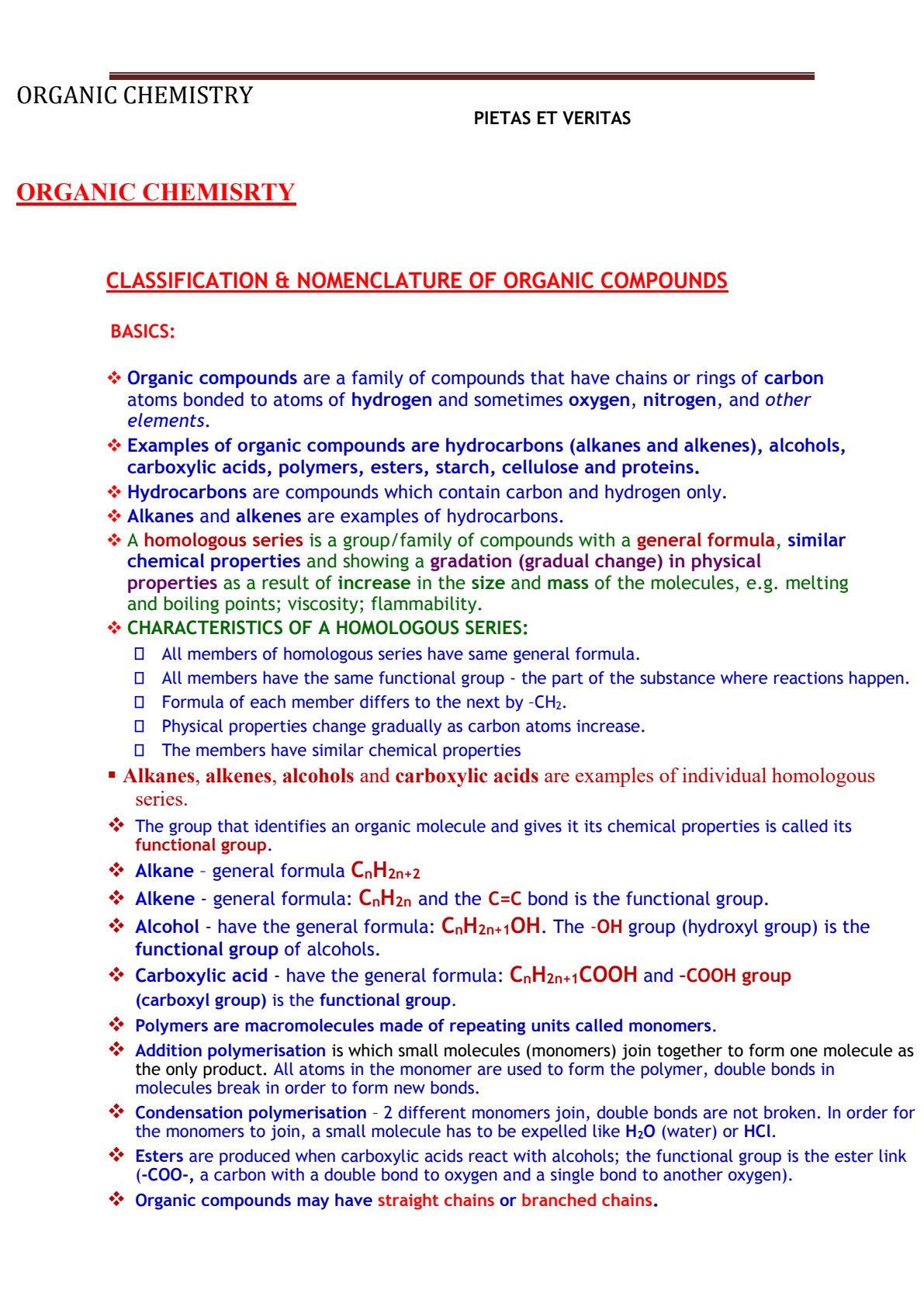
ORGANIC CHEMISTRY
PIETAS ET VERITAS

ORGANIC CHEMISRTY

CLASSIFICATION \& NOMENCLATURE OF ORGANIC COMPOUNDS
BASICS:
Organic compounds are a family of compounds that have chains or rings of carbon atoms bonded to atoms of hydrogen and sometimes oxygen, nitrogen, and other elements.
Examples of organic compounds are hydrocarbons (alkanes and alkenes), alcohols, carboxylic acids, polymers, esters, starch, cellulose and proteins.
Hydrocarbons are compounds which contain carbon and hydrogen only.
Alkanes and alkenes are examples of hydrocarbons.
A homologous series is a group/family of compounds with a general formula, similar chemical properties and showing a gradation (gradual change) in physical properties as a result of increase in the size and mass of the molecules, e.g. melting and boiling points; viscosity; flammability.
CHARACTERISTICS OF A HOMOLOGOUS SERIES:
- All members of homologous series have same general formula.
- All members have the same functional group - the part of the substance where reactions happen.
- Formula of each member differs to the next by $-\mathrm{CH}_{2}$.
- Physical properties change gradually as carbon atoms increase.
- The members have similar chemical properties
- Alkanes, alkenes, alcohols and carboxylic acids are examples of individual homologous series.
* The group that identifies an organic molecule and gives it its chemical properties is called its functional group.
* Alkane - general formula $\mathrm{C}_{\mathrm{n}} \mathrm{H}_{2 \mathrm{n}+2}$
* Alkene - general formula: $\mathrm{C}_{\mathrm{n}} \mathrm{H}_{2 \mathrm{n}}$ and the $\mathrm{C}=\mathrm{C}$ bond is the functional group.
* Alcohol - have the general formula: $\mathrm{C}_{n} \mathrm{H}_{2 n+1} \mathrm{OH}$. The -OH group (hydroxyl group) is the functional group of alcohols.
* Carboxylic acid - have the general formula: $\mathrm{C}_{n} \mathrm{H}_{2 n+1} \mathrm{COOH}$ and - COOH group (carboxyl group) is the functional group.
- Polymers are macromolecules made of repeating units called monomers.
* Addition polymerisation is which small molecules (monomers) join together to form one molecule as the only product. All atoms in the monomer are used to form the polymer, double bonds in molecules break in order to form new bonds.
* Condensation polymerisation - 2 different monomers join, double bonds are not broken. In order for the monomers to join, a small molecule has to be expelled like $\mathrm{H}_{2} \mathrm{O}$ (water) or HCl .
* Esters are produced when …