ExamineAI
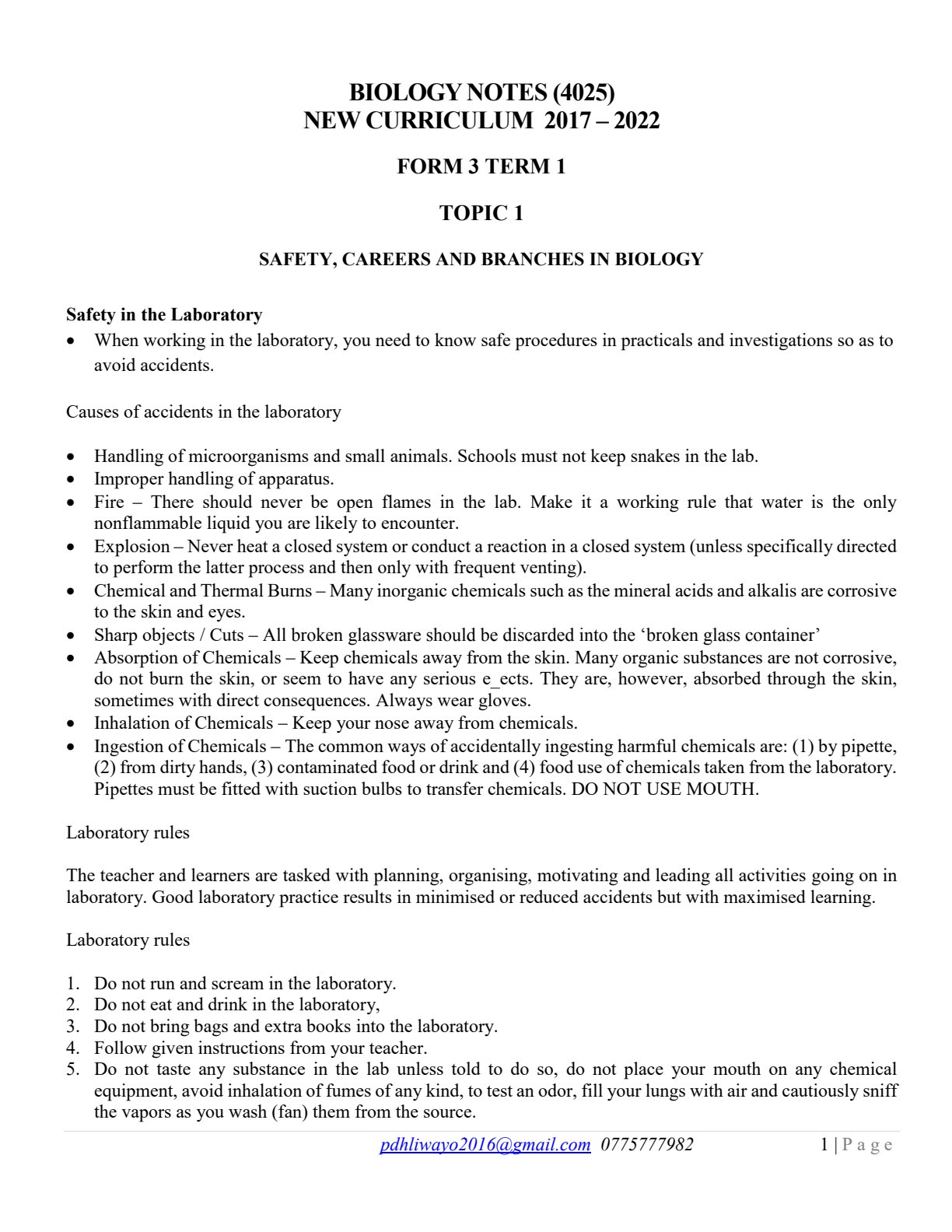
First page of O-Level Biology Safety, Careers and Branches in Biology Notes Zimbabwe

O-Level Biology Safety, Careers and Branches in Biology Notes Zimbabwe

Study Biology notes on Safety, Careers and Branches in Biology for O-Level. Useful for revision, homework, and exam preparation in Zimbabwe.

A free account is needed to download. Sign in or create one

Exam board
ZIMSEC
Subject
Biology
Level
O-Level
Document
Notes
Year
2017 to 2022
File
PDF, 4.6 MB

About this notes

This is the ZIMSEC O-Level Biology notes. It is a free notes for revision.

More Biology O-Level papers

Text from the first page

BIOLOGY NOTES (4025)
NEW CURRICULUM 2017-2022
FORM 3 TERM 1
TOPIC 1
SAFETY, CAREERS AND BRANCHES IN BIOLOGY

Safety in the Laboratory
- When working in the laboratory, you need to know safe procedures in practicals and investigations so as to avoid accidents.

Causes of accidents in the laboratory
- Handling of microorganisms and small animals. Schools must not keep snakes in the lab.
- Improper handling of apparatus.
- Fire - There should never be open flames in the lab. Make it a working rule that water is the only nonflammable liquid you are likely to encounter.
- Explosion - Never heat a closed system or conduct a reaction in a closed system (unless specifically directed to perform the latter process and then only with frequent venting).
- Chemical and Thermal Burns - Many inorganic chemicals such as the mineral acids and alkalis are corrosive to the skin and eyes.
- Sharp objects / Cuts - All broken glassware should be discarded into the 'broken glass container'
- Absorption of Chemicals - Keep chemicals away from the skin. Many organic substances are not corrosive, do not burn the skin, or seem to have any serious e ects. They are, however, absorbed through the skin, sometimes with direct consequences. Always wear gloves.
- Inhalation of Chemicals - Keep your nose away from chemicals.
- Ingestion of Chemicals - The common ways of accidentally ingesting harmful chemicals are: (1) by pipette, (2) from dirty hands, (3) contaminated food or drink and (4) food use of chemicals taken from the laboratory. Pipettes must be fitted with suction bulbs to transfer chemicals. DO NOT USE MOUTH.

Laboratory rules
The teacher and learners are tasked with planning, organising, motivating and leading all activities going on in laboratory. Good laboratory practice results in minimised or reduced accidents but with maximised learning.

Laboratory rules
1. Do not run and scream in the laboratory.
2. Do not eat and drink in the laboratory,
3. Do not bring bags and extra books into the laboratory.
4. Follow given instructions from your teacher.
5. Do not taste any substance in the lab unless told to do so, do not place your mouth on any chemical equipment, avoid inhalation of fumes of any kind, to test an odor, fill your lungs with air and cautiously sniff the vapors as you wash (fan) them from the source.

pdhliwayo2016@gmail.com 0775777982
$1 \mid \mathrm{Page}$