ExamineAI
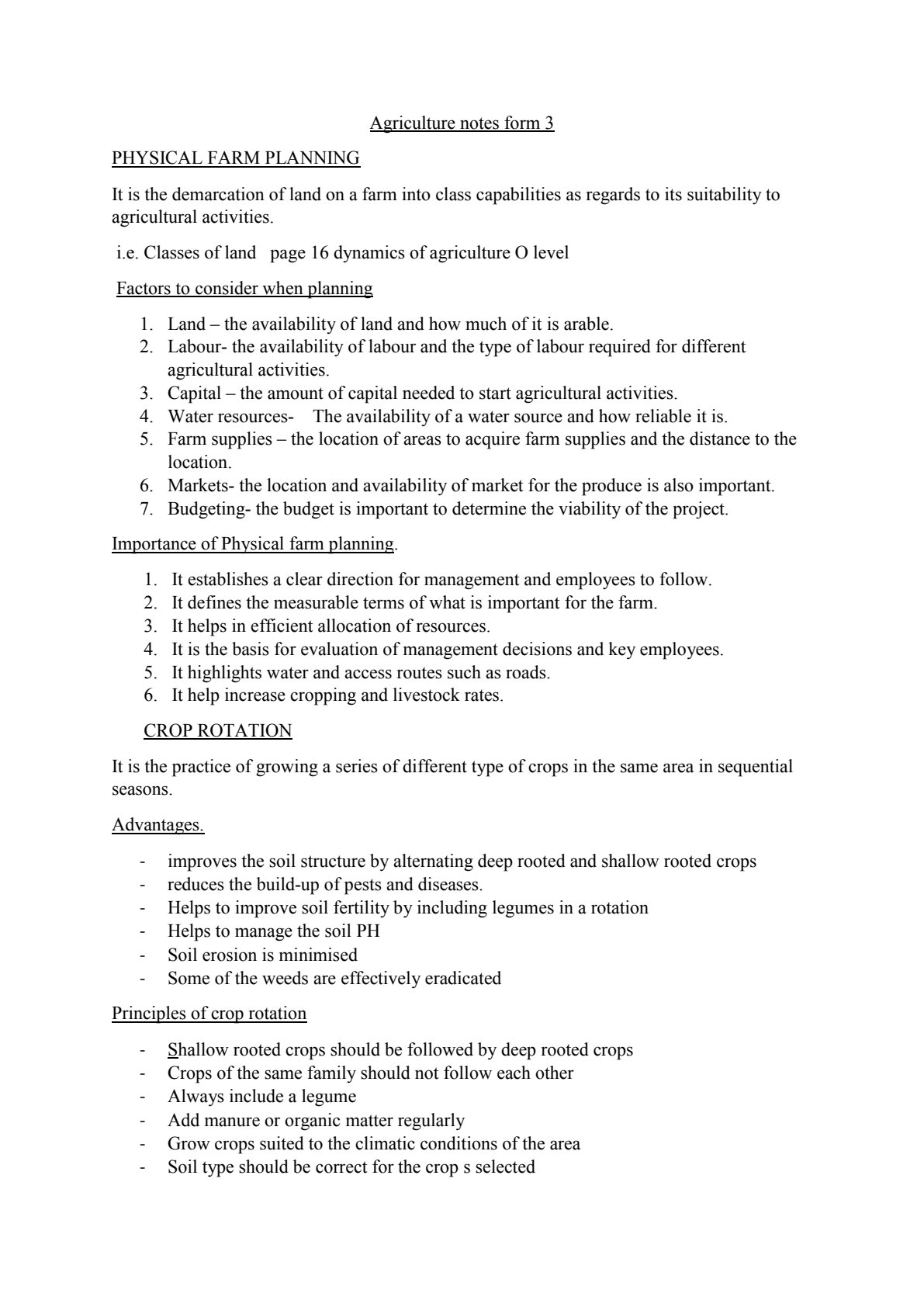
First page of O-Level Agriculture Physical Farm Planning and Crop Rotation Notes Zimbabwe

O-Level Agriculture Physical Farm Planning and Crop Rotation Notes Zimbabwe

Study Agriculture notes on Physical Farm Planning and Crop Rotation for O-Level. Useful for revision, homework, and exam preparation in Zimbabwe.

A free account is needed to download. Sign in or create one

Subject
Agriculture
Level
O-Level
Document
Notes
File
PDF, 367 KB

About this notes

This is the O-Level Agriculture notes. It is a free notes for revision.

More Agriculture O-Level papers

Text from the first page

Agriculture notes form 3
PHYSICAL FARM PLANNING
It is the demarcation of land on a farm into class capabilities as regards to its suitability to agricultural activities.
i.e. Classes of land page 16 dynamics of agriculture O level
Factors to consider when planning
1. Land - the availability of land and how much of it is arable.
2. Labour- the availability of labour and the type of labour required for different agricultural activities.
3. Capital - the amount of capital needed to start agricultural activities.
4. Water resources- The availability of a water source and how reliable it is.
5. Farm supplies - the location of areas to acquire farm supplies and the distance to the location.
6. Markets- the location and availability of market for the produce is also important.
7. Budgeting- the budget is important to determine the viability of the project.

Importance of Physical farm planning.
1. It establishes a clear direction for management and employees to follow.
2. It defines the measurable terms of what is important for the farm.
3. It helps in efficient allocation of resources.
4. It is the basis for evaluation of management decisions and key employees.
5. It highlights water and access routes such as roads.
6. It help increase cropping and livestock rates.

CROP ROTATION
It is the practice of growing a series of different type of crops in the same area in sequential seasons.

Advantages.
- improves the soil structure by alternating deep rooted and shallow rooted crops
- reduces the build-up of pests and diseases.
- Helps to improve soil fertility by including legumes in a rotation
- Helps to manage the soil PH
- Soil erosion is minimised
- Some of the weeds are effectively eradicated

Principles of crop rotation
- Shallow rooted crops should be followed by deep rooted crops
- Crops of the same family should not follow each other
- Always include a legume
- Add manure or organic matter regularly
- Grow crops suited to the climatic conditions of the area
- Soil type should be correct for the crop s selected