ExamineAI
First page of Islamic Law Sharia and Fiqh Notes Zimbabwe

Islamic Law Sharia and Fiqh Notes Zimbabwe

Study Islamic Law notes on Sharia and Fiqh. Useful for revision, homework, and exam preparation in Zimbabwe.

A free account is needed to download. Sign in or create one

Subject
Islamic Law
Document
Notes
File
PDF, 155 KB

About this notes

This is the Islamic Law notes. It is a free notes for revision.

Text from the first page

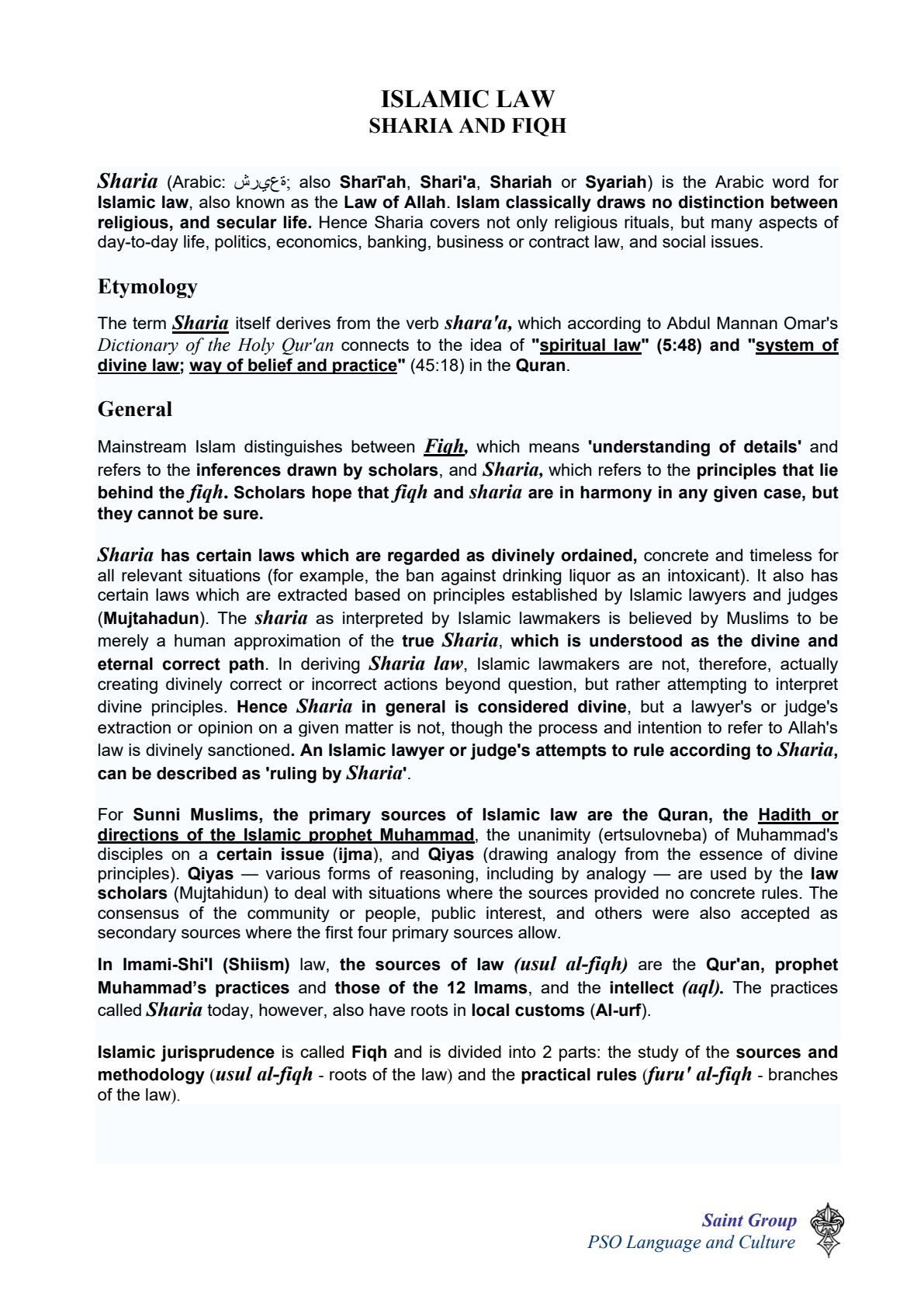
ISLAMIC LAW
SHARIA AND FIQH

Sharia (Arabic: מكيرش'; also Sharī'ah, Shari'a, Shariah or Syariah) is the Arabic word for Islamic law, also known as the Law of Allah. Islam classically draws no distinction between religious, and secular life. Hence Sharia covers not only religious rituals, but many aspects of day-to-day life, politics, economics, banking, business or contract law, and social issues.

Etymology
The term Sharia itself derives from the verb shara'a, which according to Abdul Mannan Omar's Dictionary of the Holy Qur'an connects to the idea of "spiritual law" (5:48) and "system of divine law; way of belief and practice" ( $45: 18$ ) in the Quran.

General
Mainstream Islam distinguishes between Fiqh, which means 'understanding of details' and refers to the inferences drawn by scholars, and Sharia, which refers to the principles that lie behind the fiqh. Scholars hope that fiqh and sharia are in harmony in any given case, but they cannot be sure.

Sharia has certain laws which are regarded as divinely ordained, concrete and timeless for all relevant situations (for example, the ban against drinking liquor as an intoxicant). It also has certain laws which are extracted based on principles established by Islamic lawyers and judges (Mujtahadun). The sharia as interpreted by Islamic lawmakers is believed by Muslims to be merely a human approximation of the true Sharia, which is understood as the divine and eternal correct path. In deriving Sharia law, Islamic lawmakers are not, therefore, actually creating divinely correct or incorrect actions beyond question, but rather attempting to interpret divine principles. Hence Sharia in general is considered divine, but a lawyer's or judge's extraction or opinion on a given matter is not, though the process and intention to refer to Allah's law is divinely sanctioned. An Islamic lawyer or judge's attempts to rule according to Sharia, can be described as 'ruling by Sharia'.

For Sunni Muslims, the primary sources of Islamic law are the Quran, the Hadith or directions of the Islamic prophet Muhammad, the unanimity (ertsulovneba) of Muhammad's disciples on a certain issue (ijma), and Qiyas (drawing analogy from the essence of divine principles). Qiyas - various forms of reasoning, including by analogy - are used by the law scholars (Mujtahidun) to deal with situations where the sources provided no concrete rules. The consensus of the community or people, public interest, and others were also accepted as secondary …