ExamineAI
First page of HISTORY PAPER 2 Q&A-1.pdf

HISTORY PAPER 2 Q&A-1.pdf

HISTORY PAPER 2 Q&A-1.pdf. Free PDF download (443 KB) from the ExamineAI past papers library.

A free account is needed to download. Sign in or create one

Subject
History
Level
O-Level
Document
Study Guide
Paper
Paper 2
File
PDF, 443 KB

About this study guide

This is the O-Level History study guide for Paper 2. It is a free study guide for revision.

More History O-Level papers

Other years: History O-Level

Text from the first page

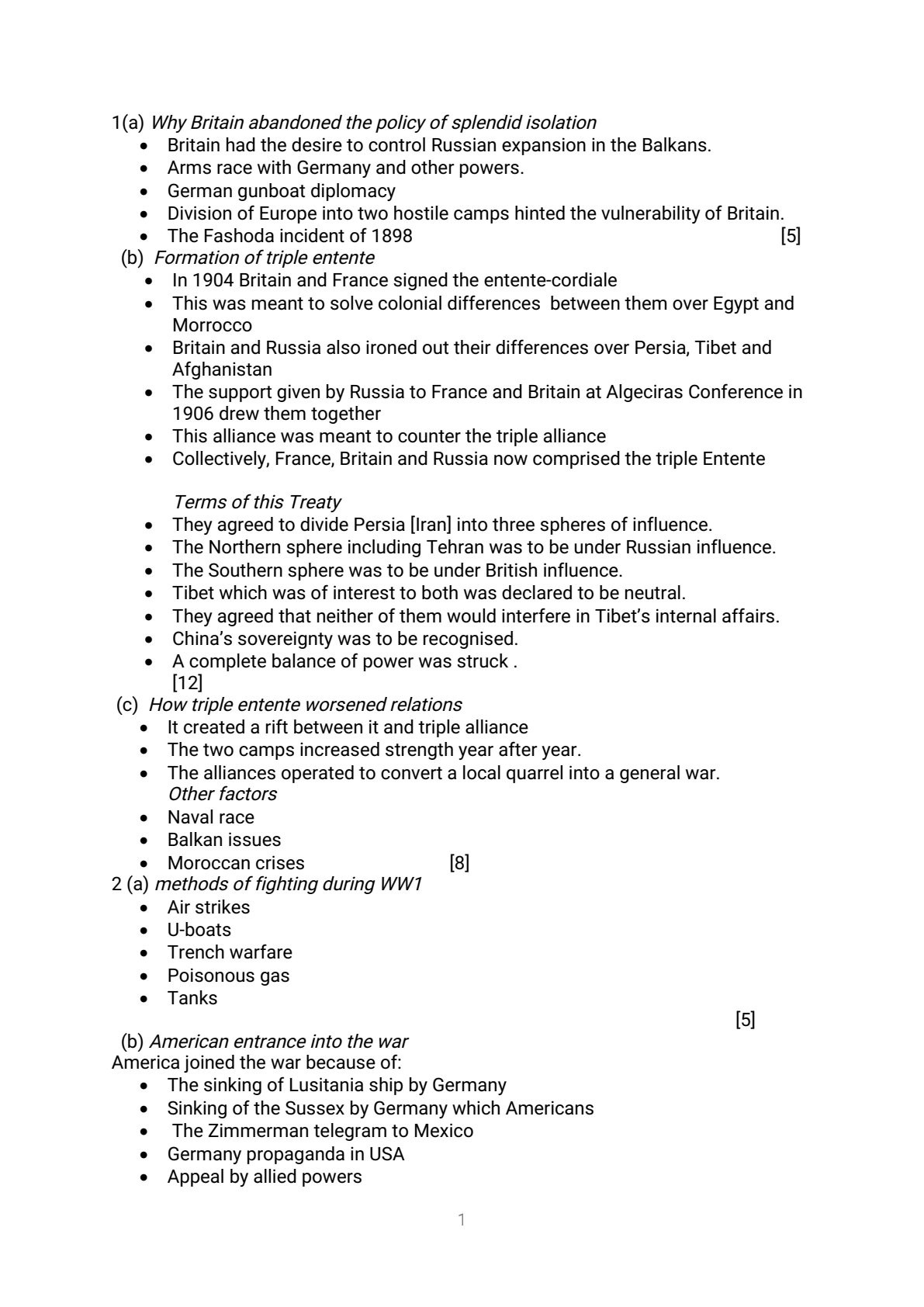
1(a) Why Britain abandoned the policy of splendid isolation
- Britain had the desire to control Russian expansion in the Balkans.
- Arms race with Germany and other powers.
- German gunboat diplomacy
- Division of Europe into two hostile camps hinted the vulnerability of Britain.
- The Fashoda incident of 1898

[5]
(b) Formation of triple entente
- In 1904 Britain and France signed the entente-cordiale
- This was meant to solve colonial differences between them over Egypt and Morrocco
- Britain and Russia also ironed out their differences over Persia, Tibet and Afghanistan
- The support given by Russia to France and Britain at Algeciras Conference in 1906 drew them together
- This alliance was meant to counter the triple alliance
- Collectively, France, Britain and Russia now comprised the triple Entente

Terms of this Treaty
- They agreed to divide Persia [Iran] into three spheres of influence.
- The Northern sphere including Tehran was to be under Russian influence.
- The Southern sphere was to be under British influence.
- Tibet which was of interest to both was declared to be neutral.
- They agreed that neither of them would interfere in Tibet's internal affairs.
- China's sovereignty was to be recognised.
- A complete balance of power was struck . [12]
(c) How triple entente worsened relations
- It created a rift between it and triple alliance
- The two camps increased strength year after year.
- The alliances operated to convert a local quarrel into a general war. Other factors
- Naval race
- Balkan issues
- Moroccan crises

[8]

2 (a) methods of fighting during WW1
- Air strikes
- U-boats
- Trench warfare
- Poisonous gas
- Tanks

[5]
(b) American entrance into the war

America joined the war because of:
- The sinking of Lusitania ship by Germany
- Sinking of the Sussex by Germany which Americans
- The Zimmerman telegram to Mexico
- Germany propaganda in USA
- Appeal by allied powers

1