ExamineAI
First page of GCSE Biology Photosynthesis and Transpiration Notes Zimbabwe

GCSE Biology Photosynthesis and Transpiration Notes Zimbabwe

Study Biology notes on Photosynthesis and Transpiration for GCSE. Useful for revision, homework, and exam preparation in Zimbabwe.

A free account is needed to download. Sign in or create one

Subject
Biology
Level
GCSE
Document
Notes
File
PDF, 14 KB

About this notes

This is the GCSE Biology notes. It is a free notes for revision.

Text from the first page

questionbase.50megs.com
GCSE Revision Notes

Biology Revision Notes - Photosynthesis And Transpiration
1. Root hair cells have a large surface area to take in water by osmosis, and minerals by active transport.
2. The transpiration stream is the flow of water from the roots to the leaves of a plant.
3. Transpiration is the loss of water from the leaves of a plant.
4. Water goes through xylem tissue, to travel from the roots to the leaves.
5. A plant uses the transpiration stream to:
- Evaporate the water to keep the plant cool.
- Keep the plant cells turgid to support the weight of the plant.
- Provide the necessary water for photosynthesis.
6. Transpiration works fastest in warm, dry, sunny, windy conditions.
7. Water is evaporated through the stomata, as well as taking in carbon dioxide and emitting oxygen.
8. Stomata are found on the underside of leaves, and control the rate of transpiration by opening and closing the guard cells.
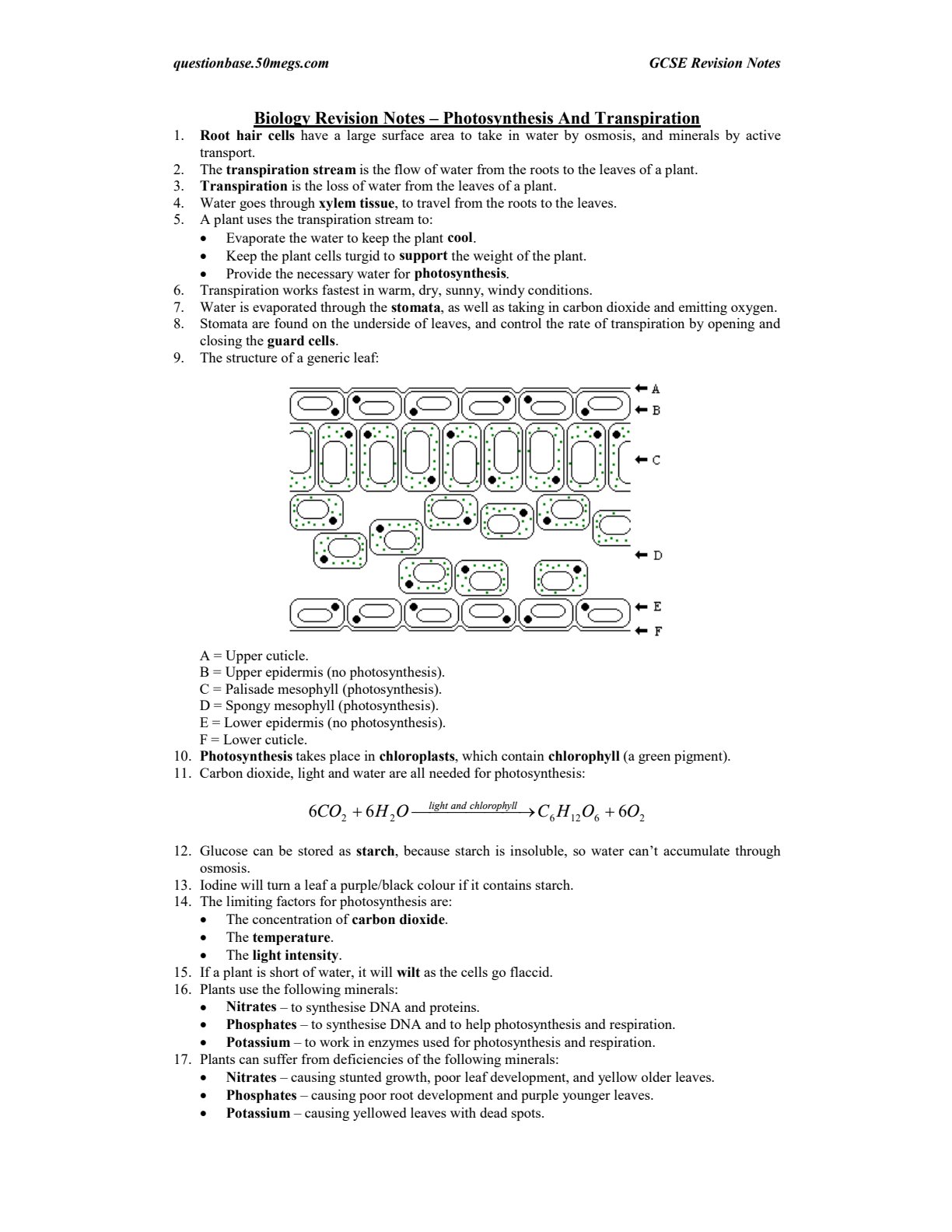
9. The structure of a generic leaf:

A = Upper cuticle.
B = Upper epidermis (no photosynthesis).
$\mathrm{C}=$ Palisade mesophyll (photosynthesis).
D = Spongy mesophyll (photosynthesis).
$\mathrm{E}=$ Lower epidermis (no photosynthesis).
$\mathrm{F}=$ Lower cuticle.
10. Photosynthesis takes place in chloroplasts, which contain chlorophyll (a green pigment).
11. Carbon dioxide, light and water are all needed for photosynthesis:
\[
6 \mathrm{CO}_{2}+6 \mathrm{H}_{2} \mathrm{O} \xrightarrow{\text { light and chlorophyll }} \mathrm{C}_{6} \mathrm{H}_{12} \mathrm{O}_{6}+6 \mathrm{O}_{2}
\]
12. Glucose can be stored as starch, because starch is insoluble, so water can't accumulate through osmosis.
13. Iodine will turn a leaf a purple/black colour if it contains starch.
14. The limiting factors for photosynthesis are:
- The concentration of carbon dioxide.
- The temperature.
- The light intensity.
15. If a plant is short of water, it will wilt as the cells go flaccid.
16. Plants use the following minerals:
- Nitrates - to synthesise DNA and proteins.
- Phosphates - to synthesise DNA and to help photosynthesis and respiration.
- Potassium - to work in enzymes used for photosynthesis and respiration.
17. Plants can suffer from deficiencies of the following minerals:
- Nitrates - causing stunted growth, poor leaf development, and yellow older leaves.
- Phosphates - causing poor root development and purple younger leaves.
- Potassium - causing yellowed leaves with dead spots.