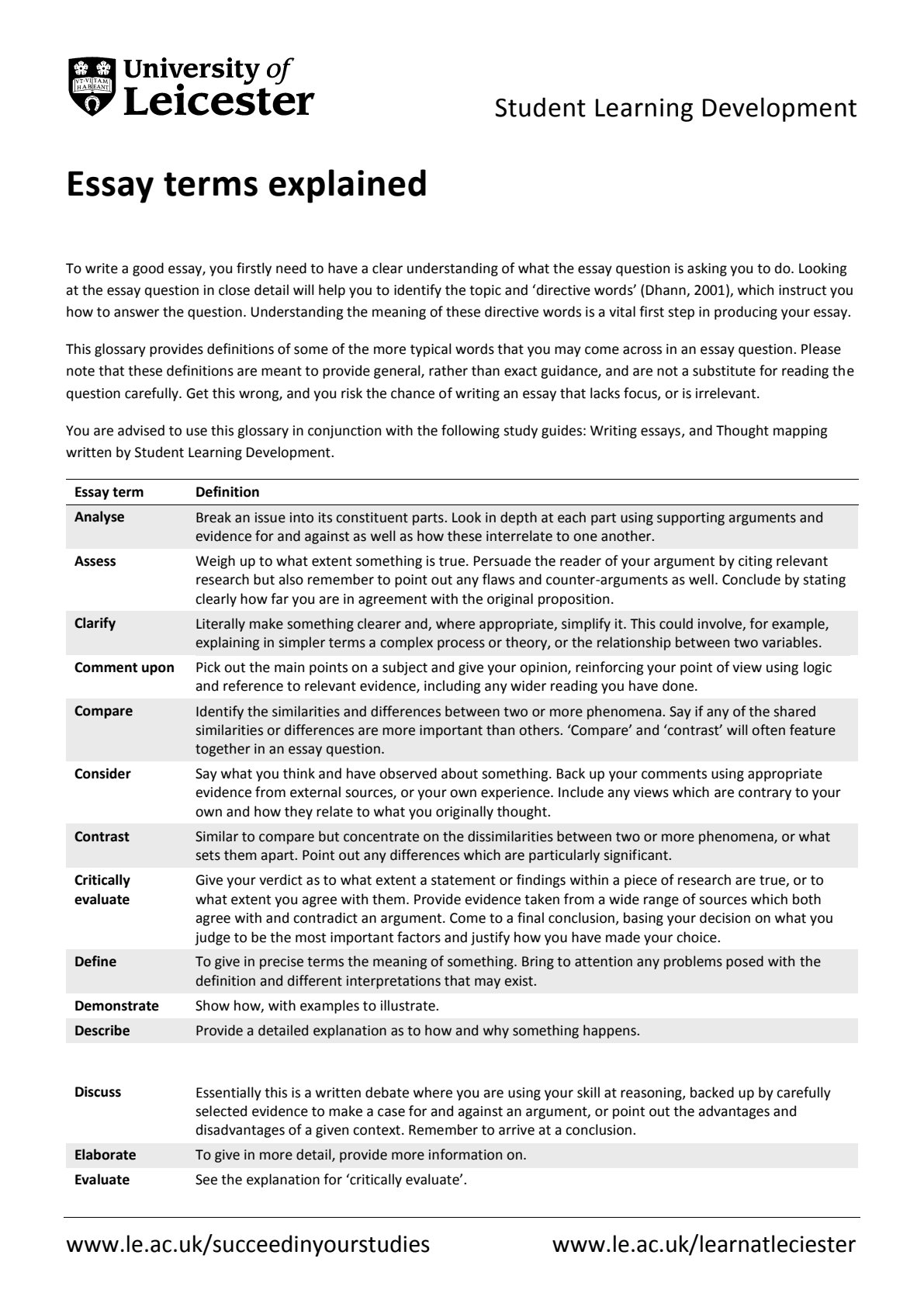
Essay terms explained
Essay terms explained. Free PDF download (326 KB) from the ExamineAI past papers library.
A free account is needed to download. Sign in or create one
- Subject
- English Language
- Document
- Study Guide
- File
- PDF, 326 KB
Essay terms explained. Free PDF download (326 KB) from the ExamineAI past papers library.
A free account is needed to download. Sign in or create one
This is the English Language study guide. It is a free study guide for revision.
University of Leicester

Student Learning Development

Essay terms explained

To write a good essay, you firstly need to have a clear understanding of what the essay question is asking you to do. Looking at the essay question in close detail will help you to identify the topic and 'directive words' (Dhann, 2001), which instruct you how to answer the question. Understanding the meaning of these directive words is a vital first step in producing your essay.

This glossary provides definitions of some of the more typical words that you may come across in an essay question. Please note that these definitions are meant to provide general, rather than exact guidance, and are not a substitute for reading the question carefully. Get this wrong, and you risk the chance of writing an essay that lacks focus, or is irrelevant.

You are advised to use this glossary in conjunction with the following study guides: Writing essays, and Thought mapping written by Student Learning Development.

 Essay term  |  Definition
 Analyse  |  Break an issue into its constituent parts. Look in depth at each part using supporting arguments and evidence for and against as well as how these interrelate to one another.
 Assess  |  Weigh up to what extent something is true. Persuade the reader of your argument by citing relevant research but also remember to point out any flaws and counter-arguments as well. Conclude by stating clearly how far you are in agreement with the original proposition.
 Clarify  |  Literally make something clearer and, where appropriate, simplify it. This could involve, for example, explaining in simpler terms a complex process or theory, or the relationship between two variables.
 Comment upon  |  Pick out the main points on a subject and give your opinion, reinforcing your point of view using logic and reference to relevant evidence, including any wider reading you have done.
 Compare  |  Identify the similarities and differences between two or more phenomena. Say if any of the shared similarities or differences are more important than others. 'Compare' and 'contrast' will often feature together in an essay question.
 Consider  |  Say what you think and have observed about something. Back up your comments using appropriate evidence from external sources, or your own experience. Include any views which are contrary to your own and how they relate to what you originally thought.
 Contrast  |  Similar to compare but concentrate on the dissimilarities between two …