ExamineAI
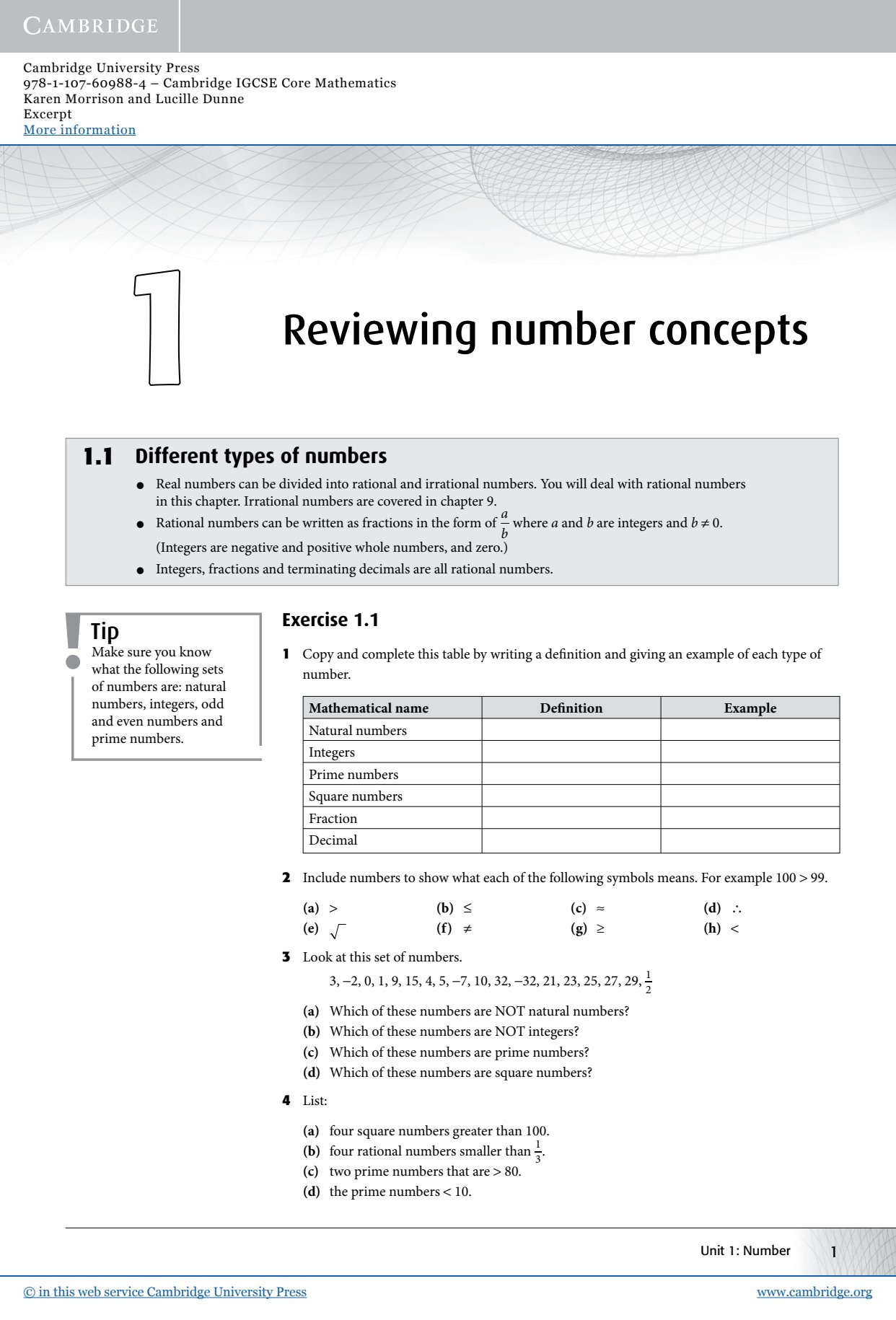
First page of Cambridge IGCSE Core Mathematics Mathematics Secondary

Cambridge IGCSE Core Mathematics Mathematics Secondary

Access this Mathematics textbook for Secondary. Useful for learning, classroom study, and revision in Zimbabwe.

A free account is needed to download. Sign in or create one

Exam board
Cambridge International Examinations
Subject
Mathematics
Document
Textbook
File
PDF, 594 KB

About this textbook

This is the Cambridge International Examinations Mathematics textbook. It is a free textbook for revision.

More Mathematics papers

Other years: Mathematics

Text from the first page

CAMBRIDGE
Cambridge University Press
978-1-107-60988-4 - Cambridge IGCSE Core Mathematics
Karen Morrison and Lucille Dunne
Excerpt
More information

Reviewing number concepts
1.1 Different types of numbers
- Real numbers can be divided into rational and irrational numbers. You will deal with rational numbers in this chapter. Irrational numbers are covered in chapter 9.
- Rational numbers can be written as fractions in the form of $\frac{a}{b}$ where $a$ and $b$ are integers and $b \neq 0$. (Integers are negative and positive whole numbers, and zero.)
- Integers, fractions and terminating decimals are all rational numbers.

Tip
Make sure you know what the following sets of numbers are: natural numbers, integers, odd and even numbers and prime numbers.

Exercise 1.1
1 Copy and complete this table by writing a definition and giving an example of each type of number.

 Mathematical name  |  Definition  |  Example
 Natural numbers  |  &
 Integers  |  &
 Prime numbers  |  &
 Square numbers  |  &
 Fraction  |  &
 Decimal  |  &

2 Include numbers to show what each of the following symbols means. For example $100>99$.
(a) $>$
(b) $\leq$
(c) $\approx$
(d) $\therefore$
(e) $\sqrt{ }$
(f) $\neq$
(g) $\geq$
(h) <

3 Look at this set of numbers.
\[
3,-2,0,1,9,15,4,5,-7,10,32,-32,21,23,25,27,29, \frac{1}{2}
\]
(a) Which of these numbers are NOT natural numbers?
(b) Which of these numbers are NOT integers?
(c) Which of these numbers are prime numbers?
(d) Which of these numbers are square numbers?

4 List:
(a) four square numbers greater than 100 .
(b) four rational numbers smaller than $\frac{1}{3}$.
(c) two prime numbers that are $>80$.
(d) the prime numbers $<10$.

Unit 1: Number
1
© in this web service Cambridge University Press
www.cambridge.org