Atomic Structure
Atomic Structure. Free PDF download (277 KB) from the ExamineAI past papers library.
A free account is needed to download. Sign in or create one
- Subject
- Chemistry
- Level
- A-Level
- Document
- Study Guide
- File
- PDF, 277 KB
Atomic Structure. Free PDF download (277 KB) from the ExamineAI past papers library.
A free account is needed to download. Sign in or create one
This is the A-Level Chemistry study guide. It is a free study guide for revision.
Atomic Structure

\begin{table}
\captionsetup{labelformat=empty}
\caption{Details of the three Sub-atomic (fundamental) Particles}

 Particle  |  Position  |  Relative Mass  |  Relative Charge
 Proton  |  Nucleus  |  1  |  +1
 Neutron  |  Nucleus  |  1  |  0
 Electron  |  Orbitals  |  $1 / 1800$  |  -1

\end{table}

There are various models for atomic structure

An atom of Lithium (Li) can be represented as follows:
$\begin{aligned} \text { Mass Number }  |  \rightarrow \mathbf{7} \quad \mathbf{L i} \leftarrow \text { Atomic Symbol }  \text { Atomic Number }  |  \rightarrow \mathbf{3}\end{aligned}$
The atomic number, $Z$, is the number of protons in the nucleus.
The mass number , A , is the total number of protons and neutrons in the atom.
Number of neutrons $=\mathbf{A}-\mathbf{Z}$
Isotopes
Isotopes are atoms with the same number of protons, but different numbers of neutrons.

Isotopes have similar chemical properties because they have the same electronic structure. They may have slightly varying physical properties because they have different masses.

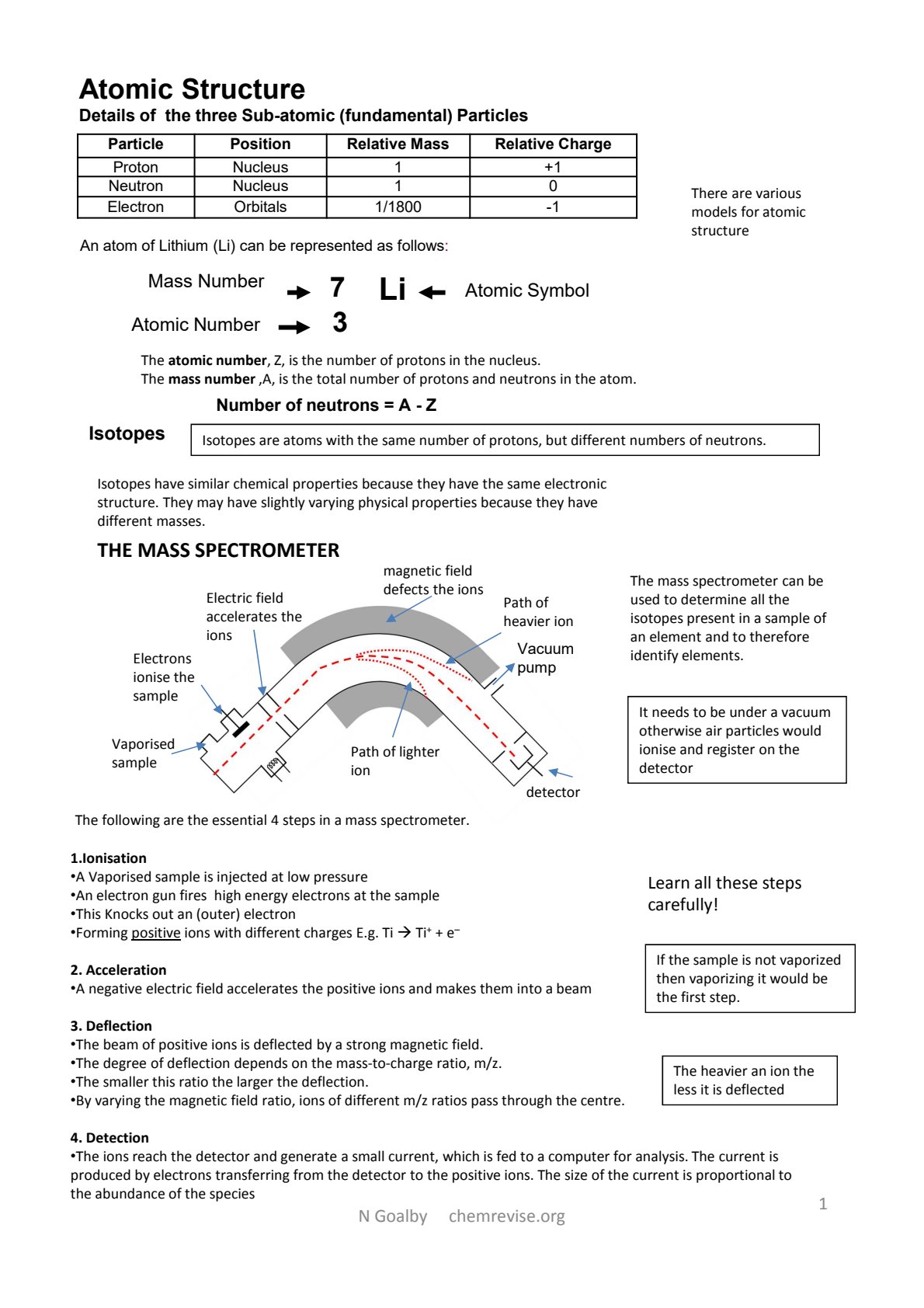
THE MASS SPECTROMETER

The following are the essential 4 steps in a mass spectrometer.
1.lonisation
-A Vaporised sample is injected at low pressure
-An electron gun fires high energy electrons at the sample
Learn all these steps
-This Knocks out an (outer) electron carefully!
-Forming positive ions with different charges E.g. $\mathrm{Ti} \rightarrow \mathrm{Ti}^{+}+\mathrm{e}^{-}$
2. Acceleration
-A negative electric field accelerates the positive ions and makes them into a beam

If the sample is not vaporized then vaporizing it would be the first step.
3. Deflection
-The beam of positive ions is deflected by a strong magnetic field.
-The degree of deflection depends on the mass-to-charge ratio, m/z.
-The smaller this ratio the larger the deflection.

The heavier an ion the less it is deflected
-By varying the magnetic field ratio, ions of different $\mathrm{m} / \mathrm{z}$ ratios pass through the centre.
4. Detection
-The ions reach the detector and generate a small current, which is fed to a computer for analysis. The current is produced by electrons transferring from the detector to the positive ions. The size of the current is proportional to the abundance of the species

1
N Goalby chemrevise.org