ExamineAI
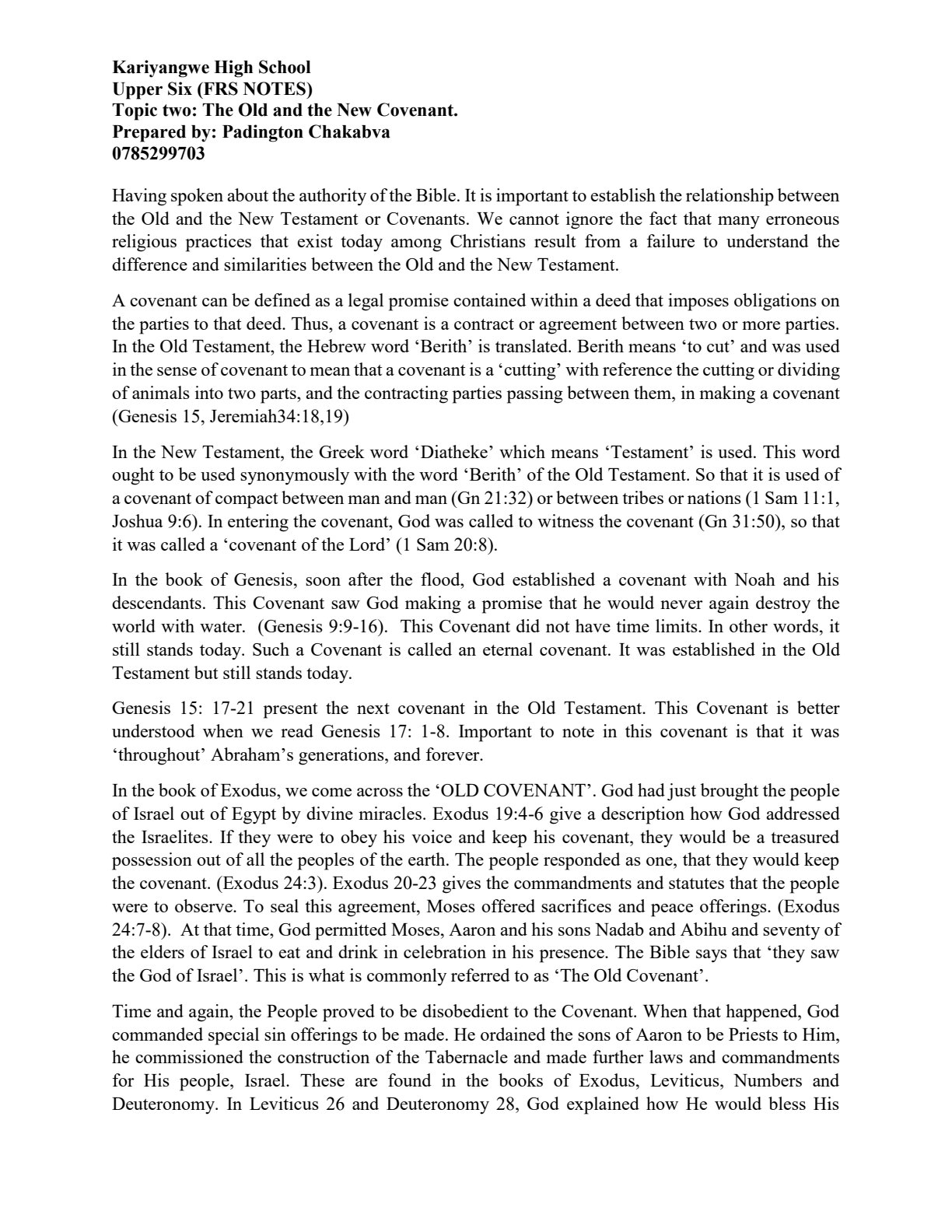
First page of A-Level Religious Studies The Old and the New Covenant Notes Zimbabwe

A-Level Religious Studies The Old and the New Covenant Notes Zimbabwe

Study Religious Studies notes on The Old and the New Covenant for A-Level. Useful for revision, homework, and exam preparation in Zimbabwe.

A free account is needed to download. Sign in or create one

Subject
Religious Studies
Level
A-Level
Document
Notes
File
PDF, 229 KB

About this notes

This is the A-Level Religious Studies notes. It is a free notes for revision.

More Religious Studies A-Level papers

Text from the first page

Kariyangwe High School
Upper Six (FRS NOTES)
Topic two: The Old and the New Covenant.
Prepared by: Padington Chakabva
0785299703
Having spoken about the authority of the Bible. It is important to establish the relationship between the Old and the New Testament or Covenants. We cannot ignore the fact that many erroneous religious practices that exist today among Christians result from a failure to understand the difference and similarities between the Old and the New Testament.

A covenant can be defined as a legal promise contained within a deed that imposes obligations on the parties to that deed. Thus, a covenant is a contract or agreement between two or more parties. In the Old Testament, the Hebrew word 'Berith' is translated. Berith means 'to cut' and was used in the sense of covenant to mean that a covenant is a 'cutting' with reference the cutting or dividing of animals into two parts, and the contracting parties passing between them, in making a covenant (Genesis 15, Jeremiah34:18,19)

In the New Testament, the Greek word 'Diatheke' which means 'Testament' is used. This word ought to be used synonymously with the word 'Berith' of the Old Testament. So that it is used of a covenant of compact between man and man (Gn 21:32) or between tribes or nations (1 Sam 11:1, Joshua 9:6). In entering the covenant, God was called to witness the covenant (Gn 31:50), so that it was called a 'covenant of the Lord' (1 Sam 20:8).

In the book of Genesis, soon after the flood, God established a covenant with Noah and his descendants. This Covenant saw God making a promise that he would never again destroy the world with water. (Genesis 9:9-16). This Covenant did not have time limits. In other words, it still stands today. Such a Covenant is called an eternal covenant. It was established in the Old Testament but still stands today.

Genesis 15: 17-21 present the next covenant in the Old Testament. This Covenant is better understood when we read Genesis 17: 1-8. Important to note in this covenant is that it was 'throughout' Abraham's generations, and forever.

In the book of Exodus, we come across the 'OLD COVENANT'. God had just brought the people of Israel out of Egypt by divine miracles. Exodus 19:4-6 give a description how God addressed the Israelites. If they were to obey his voice and keep his covenant, they would be a treasured possession out of all the peoples of the earth. The people responded as one, that they would keep the covenant. (Exodus 24:3). Exodus …