ExamineAI
First page of A-Level Pure Mathematicslgebra Notes Zimbabwe

A-Level Pure Mathematicslgebra Notes Zimbabwe

Study Pure Mathematics notes on Algebra for A-Level. Useful for revision, homework, and exam preparation in Zimbabwe.

A free account is needed to download. Sign in or create one

Subject
Pure Mathematics
Level
A-Level
Document
Notes
File
PDF, 3.7 MB

About this notes

This is the A-Level Pure Mathematics notes. It is a free notes for revision.

More Pure Mathematics A-Level papers

Other years: Pure Mathematics A-Level

Text from the first page

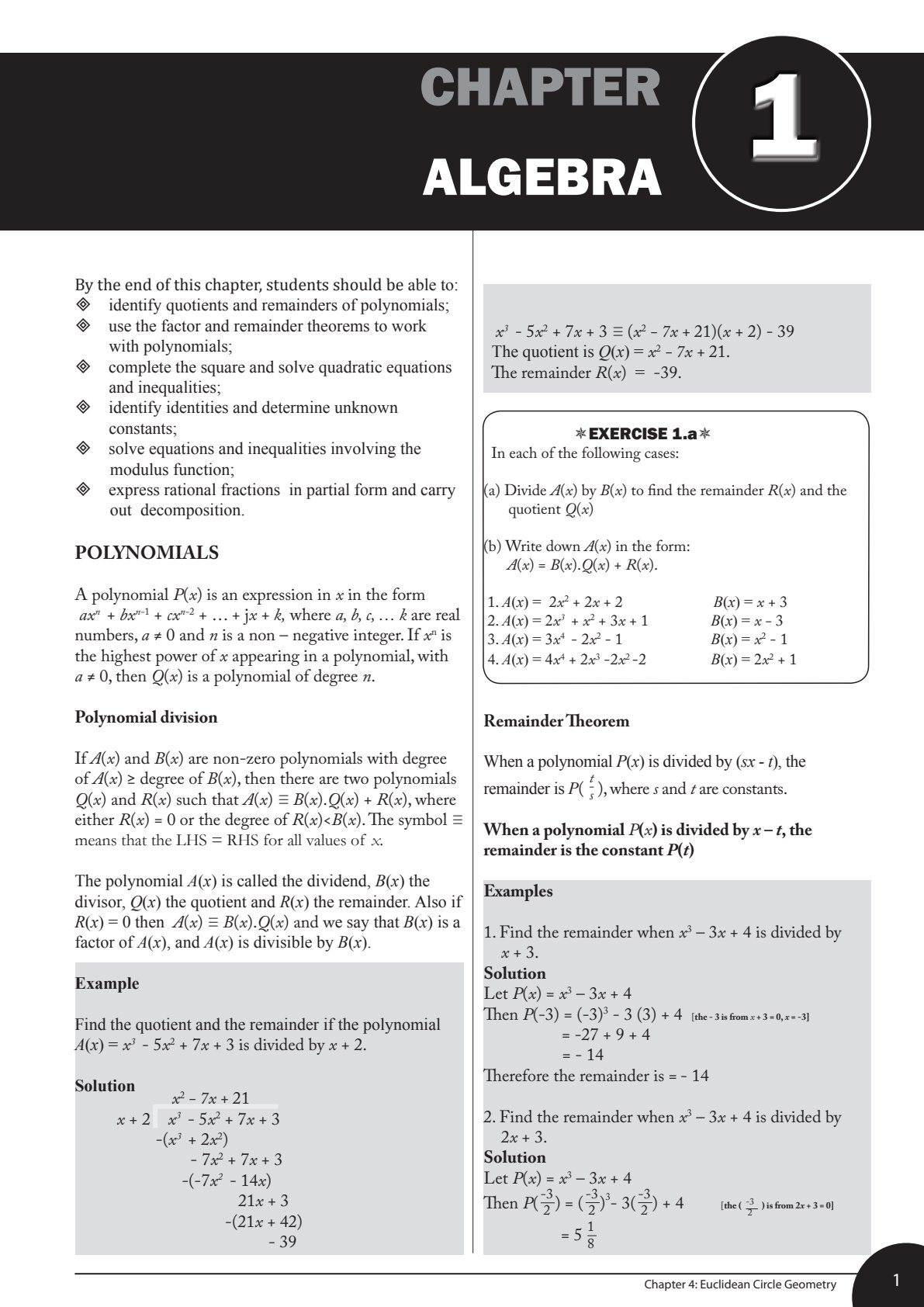
CHAPTER ALGEBRA

By the end of this chapter, students should be able to:
- identify quotients and remainders of polynomials;
- use the factor and remainder theorems to work with polynomials;
- complete the square and solve quadratic equations and inequalities;
- identify identities and determine unknown constants;
- solve equations and inequalities involving the modulus function;
- express rational fractions in partial form and carry out decomposition.

POLYNOMIALS

A polynomial $P(x)$ is an expression in $x$ in the form $a x^{n}+b x^{n-1}+c x^{n-2}+\ldots+\mathrm{j} x+k$, where $a, b, c, \ldots k$ are real numbers, $a \neq 0$ and $n$ is a non - negative integer. If $x^{\mathrm{n}}$ is the highest power of $x$ appearing in a polynomial, with $a \neq 0$, then $Q(x)$ is a polynomial of degree $n$.

Polynomial division
If $A(x)$ and $B(x)$ are non-zero polynomials with degree of $A(x) \geq$ degree of $B(x)$, then there are two polynomials $Q(x)$ and $R(x)$ such that $A(x) \equiv B(x) \cdot Q(x)+R(x)$, where either $R(x)=0$ or the degree of $R(x)<B(x)$. The symbol $\equiv$ means that the LHS $=$ RHS for all values of $x$.

The polynomial $A(x)$ is called the dividend, $B(x)$ the divisor, $Q(x)$ the quotient and $R(x)$ the remainder. Also if $R(x)=0$ then $A(x) \equiv B(x) \cdot Q(x)$ and we say that $B(x)$ is a factor of $A(x)$, and $A(x)$ is divisible by $B(x)$.

Example
Find the quotient and the remainder if the polynomial $A(x)=x^{3}-5 x^{2}+7 x+3$ is divided by $x+2$.

Solution
\[
x+2 \begin{array}{c}
x^{2}-7 x+21
x^{3}-5 x^{2}+7 x+3
-\left(x^{3}+2 x^{2}\right)
-7 x^{2}+7 x+3
-\left(-7 x^{2}-14 x\right)
21 x+3
-(21 x+42)
-39
\end{array}
\]
\[
x^{3}-5 x^{2}+7 x+3 \equiv\left(x^{2}-7 x+21\right)(x+2)-39
\]

The quotient is $Q(x)=x^{2}-7 x+21$.
The remainder $R(x)=-39$.
*EXERCISE 1.a*
In each of the following cases:
(a) Divide $A(x)$ by $B(x)$ to find the remainder $R(x)$ and the quotient $Q(x)$
(b) Write down $A(x)$ in the form:
$A(x)=B(x) \cdot Q(x)+R(x)$.
1. $A(x)=2 x^{2}+2 x+2$
$B(x)=x+3$
2. $A(x)=2 x^{3}+x^{2}+3 x+1 B(x)=x-3$
3. $A(x)=3 x^{4}-2 x^{2}-1 B(x)=x^{2}-1$
4. $A(x)=4 x^{4}+2 x^{3}-2 x^{2}-2 B(x)=2 x^{2}+1$

Remainder Theorem
When a polynomial $P(x)$ is divided by $(s x-t)$, the remainder is $P\left(\frac{t}{s}\right)$, where $s$ and $t$ are constants.

When a polynomial $P(x)$ is divided by $x-t$, the remainder is the constant $P(t)$

Examples
1. Find the remainder when $x^{3}-3 x+4$ is divided by $x+3$.
Solution
Let $P(x)=x^{3}-3 x+4$
Then …