ExamineAI
First page of A-Level Physics Matter Temperature Scales Notes Zimbabwe

A-Level Physics Matter Temperature Scales Notes Zimbabwe

Study Physics notes on Matter Temperature Scales for A-Level. Useful for revision, homework, and exam preparation in Zimbabwe.

A free account is needed to download. Sign in or create one

Subject
Physics
Level
A-Level
Document
Notes
File
PDF, 18 KB

About this notes

This is the A-Level Physics notes. It is a free notes for revision.

More Physics A-Level papers

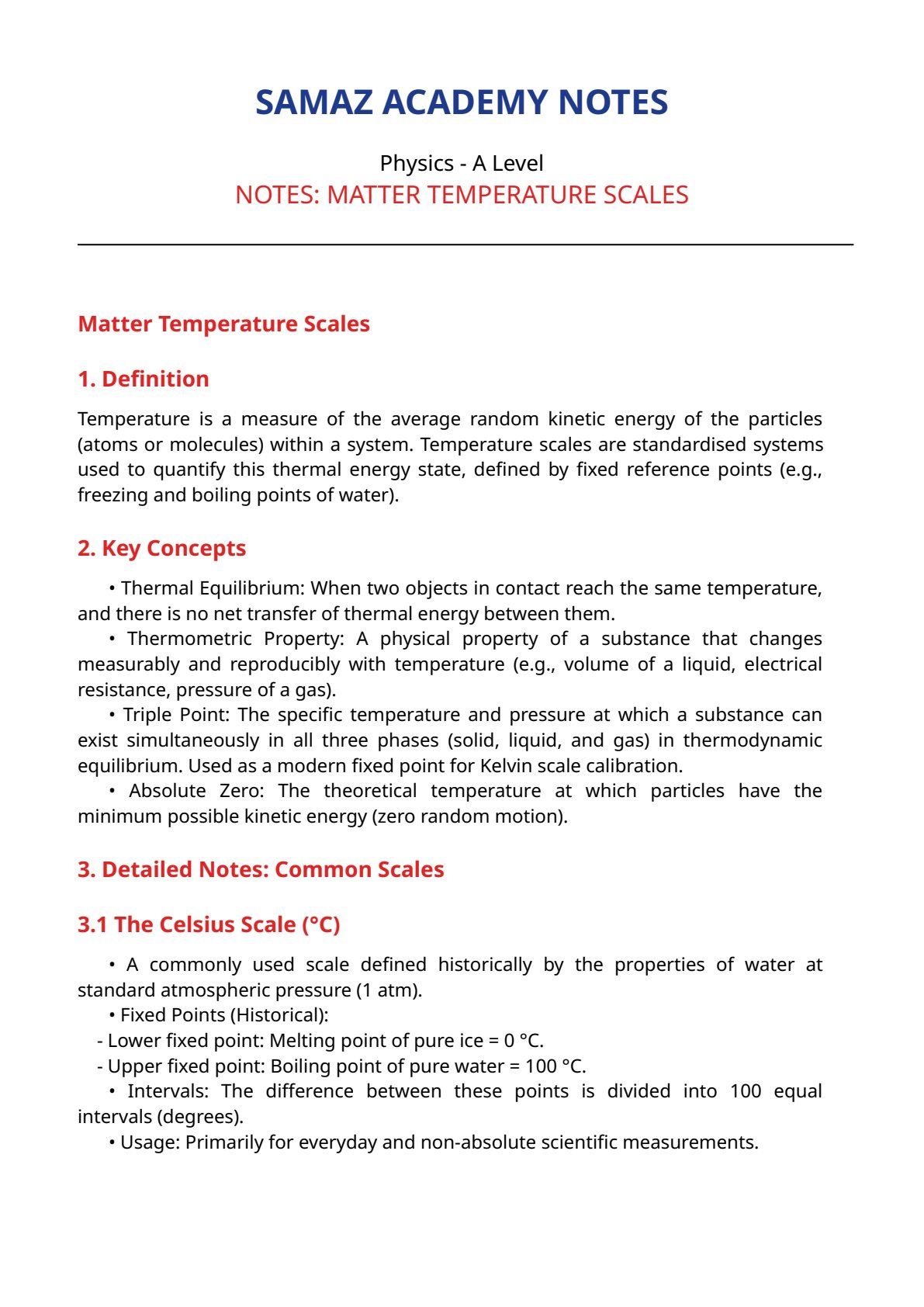
Text from the first page

SAMAZ ACADEMY NOTES

Physics - A Level
NOTES: MATTER TEMPERATURE SCALES

Matter Temperature Scales
1. Definition

Temperature is a measure of the average random kinetic energy of the particles (atoms or molecules) within a system. Temperature scales are standardised systems used to quantify this thermal energy state, defined by fixed reference points (e.g., freezing and boiling points of water).
2. Key Concepts
- Thermal Equilibrium: When two objects in contact reach the same temperature, and there is no net transfer of thermal energy between them.
- Thermometric Property: A physical property of a substance that changes measurably and reproducibly with temperature (e.g., volume of a liquid, electrical resistance, pressure of a gas).
- Triple Point: The specific temperature and pressure at which a substance can exist simultaneously in all three phases (solid, liquid, and gas) in thermodynamic equilibrium. Used as a modern fixed point for Kelvin scale calibration.
- Absolute Zero: The theoretical temperature at which particles have the minimum possible kinetic energy (zero random motion).
3. Detailed Notes: Common Scales
3.1 The Celsius Scale ( ${ }^{\circ} \mathrm{C}$ )
- A commonly used scale defined historically by the properties of water at standard atmospheric pressure (1 atm).
- Fixed Points (Historical):
- Lower fixed point: Melting point of pure ice $=0^{\circ} \mathrm{C}$.
- Upper fixed point: Boiling point of pure water $=100^{\circ} \mathrm{C}$.
- Intervals: The difference between these points is divided into 100 equal intervals (degrees).
- Usage: Primarily for everyday and non-absolute scientific measurements.