ExamineAI
First page of A-Level Economics Economic Growth vs Economic Development Notes Zimbabwe

A-Level Economics Economic Growth vs Economic Development Notes Zimbabwe

Study Economics notes on Economic Growth vs Economic Development for A-Level. Useful for revision, homework, and exam preparation in Zimbabwe.

A free account is needed to download. Sign in or create one

Subject
Economics
Level
A-Level
Document
Notes
Paper
Paper 3
Session
June
Year
2017
File
PDF, 622 KB

About this notes

This is the A-Level Economics notes for Paper 3 from June 2017. It is a free notes for revision.

More Economics A-Level 2017 papers

Other years: Economics A-Level

Text from the first page

Trotter on Economic growth Vs Economic development
0774998145

JUNE 2017 p3 QN 11
11. a) Distinguish between economic growth and economic development.
[10]
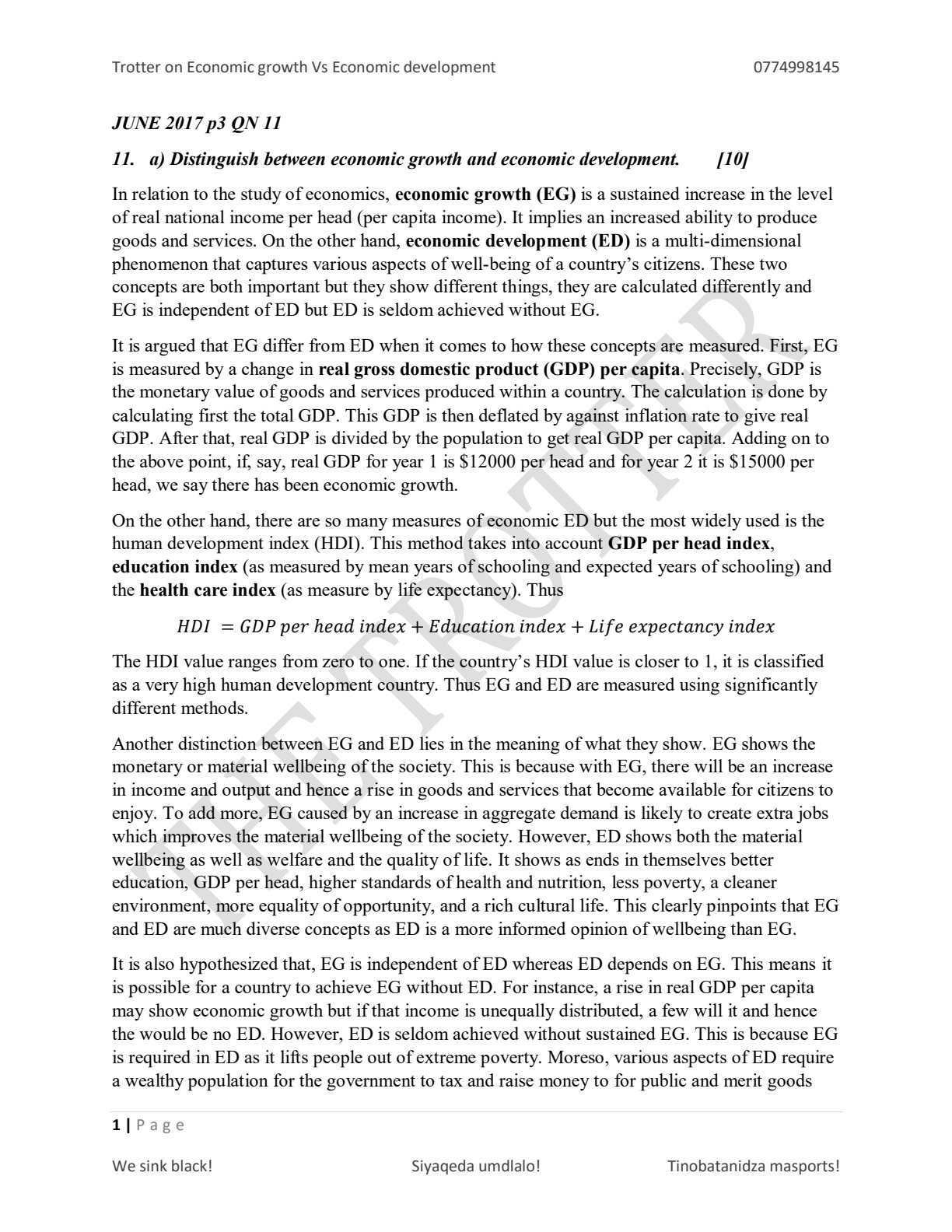
In relation to the study of economics, economic growth (EG) is a sustained increase in the level of real national income per head (per capita income). It implies an increased ability to produce goods and services. On the other hand, economic development (ED) is a multi-dimensional phenomenon that captures various aspects of well-being of a country's citizens. These two concepts are both important but they show different things, they are calculated differently and EG is independent of ED but ED is seldom achieved without EG .

It is argued that EG differ from ED when it comes to how these concepts are measured. First, EG is measured by a change in real gross domestic product (GDP) per capita. Precisely, GDP is the monetary value of goods and services produced within a country. The calculation is done by calculating first the total GDP. This GDP is then deflated by against inflation rate to give real GDP. After that, real GDP is divided by the population to get real GDP per capita. Adding on to the above point, if, say, real GDP for year 1 is $$ 12000$ per head and for year 2 it is $$ 15000$ per head, we say there has been economic growth.

On the other hand, there are so many measures of economic ED but the most widely used is the human development index (HDI). This method takes into account GDP per head index, education index (as measured by mean years of schooling and expected years of schooling) and the health care index (as measure by life expectancy). Thus
\[
H D I=G D P \text { per head index }+ \text { Education index }+ \text { Life expectancy index }
\]

The HDI value ranges from zero to one. If the country's HDI value is closer to 1 , it is classified as a very high human development country. Thus EG and ED are measured using significantly different methods.

Another distinction between EG and ED lies in the meaning of what they show. EG shows the monetary or material wellbeing of the society. This is because with EG, there will be an increase in income and output and hence a rise in goods and services that become available for citizens to enjoy. To add more, EG caused by an increase in aggregate demand is likely to create extra jobs which improves the material wellbeing of the society. However, ED shows both the material wellbeing as well as welfare and the quality of life. It shows as ends …